
Karma Metric is a synthetic indicator that evaluates a domain based on data from Wayback Machine. It reflects how long, regularly, and consistently a site has existed and attracted interest from automated web crawlers. In this article, we'll explain how it works, why link-based metrics have limitations, what Karma Metric consists of, and how to read it in practice.
Table of Contents
- Table of Contents
- Introduction
- What is Karma Metric
- Theoretical Foundations of the Approach
- Why Link-Based Metrics Have Limitations
- What Karma Metric Consists Of
- How to Read Karma Metric in Practice
- How to Enable Karma Metric in the Table in Karma.Domains
- Why Karma Metric is Not a Google Metric
- Connection with Other Karma.Domains Metrics
- When Karma Metric is Especially Useful
- Limitations and Honest Assumptions
- FAQ: Karma Metric — Questions and Answers
- 1. What Does Karma Metric Actually Measure?
- 2. Can Karma Metric Be Considered a Domain Authority Indicator?
- 3. How Does Karma Metric Differ from Ahrefs DR, Moz DA, and Similar Metrics?
- 4. Why Can a Domain with Few Snapshots Have a Non-Zero Karma Metric?
- 5. Why Can Old but "Quiet" Domains Have Lower Karma Metric Than Expected?
- 6. Can Karma Metric Be Manipulated?
- 7. Why Should We Trust Karma Metric at All Then?
- 8. Why Use Karma Metric Together with Karma Score?
- 9. Can a Domain with High Karma Metric Be Bad for SEO?
- 10. In What Cases is Karma Metric Especially Useful?
- Conclusion
Introduction
In SEO, there has long been a temptation to measure "domain authority" with a single number. Domain Rating, Domain Authority, Authority Score, Trust Flow — all these metrics have become familiar benchmarks when analyzing sites, drop domains, and link donors. But there's one problem: almost all of them are based on links in one form or another.
Links are indeed important. Historically, it was PageRank that became the foundation of search algorithms. But over time, link-based metrics have turned into a market of their own — with buying, manipulation, networks, and complex manipulation schemes. As a result, a high link metric increasingly speaks not to the quality of a site, but to how well it "plays by SEO rules."
Karma Metric emerged as an attempt to look at domain authority from a different angle — not through links, but through its real history of existence and activity on the web.
What is Karma Metric
Karma Metric is a synthetic indicator that evaluates a domain based on data from Wayback Machine. It reflects how long, regularly, and consistently a site has existed and attracted interest from automated web crawlers.
It is displayed as a value ranging from 0 to 100, where 0 is the lowest score and 100 is the highest.

Instead of analyzing the link graph, Karma Metric analyzes domain behavior over time:
- how often the site was archived,
- whether there were long periods of disappearance,
- how uniform the activity was,
- whether interest in the site grew or, conversely, faded.
It's important to immediately set the boundary: Karma Metric is not a Google ranking indicator and not its direct equivalent. It's an independent model designed to analyze domain history and assess its stability.
Theoretical Foundations of the Approach
The idea of using archiving data is based on several observations and studies.
Crawl Priority and Attention Distribution
Search and archival systems don't crawl the internet evenly. Both Google, Internet Archive, and Common Crawl use complex prioritization algorithms:
- sites with frequent updates are visited more often,
- stable and in-demand resources receive a larger crawl budget,
- abandoned or unstable sites are crawled less frequently over time.
These principles are described in Google patents on crawl scheduling and adaptive crawling, as well as in publications by the Common Crawl and Internet Archive teams.
Although Wayback Machine is not a search engine, its crawler operates on similar logic: it spends resources where it sees value or activity.
Archiving as an Indirect Quality Signal
The frequency and depth of archiving don't guarantee a "good site," but they are a strong indirect signal:
- the site actually existed,
- it was accessible,
- it was updated or at least remained relevant long enough,
- it was returned to again and again.
It is these signals that form the basis of Karma Metric.
Why Link-Based Metrics Have Limitations
Link-based metrics aren't "bad" — they simply have systemic limitations:
- Manipulability: links are bought, rented, and generated automatically.
- Inertia: high DR or TF can persist for years after a site's actual death.
- Blind spots: new but live projects look "weak" for a long time.
- Disconnect from real usage: links don't reflect whether the site is working now.
Karma Metric doesn't try to replace these indicators — it adds a temporal dimension to them.
What Karma Metric Consists Of
The metric consists of four components, each reflecting a separate aspect of domain history.
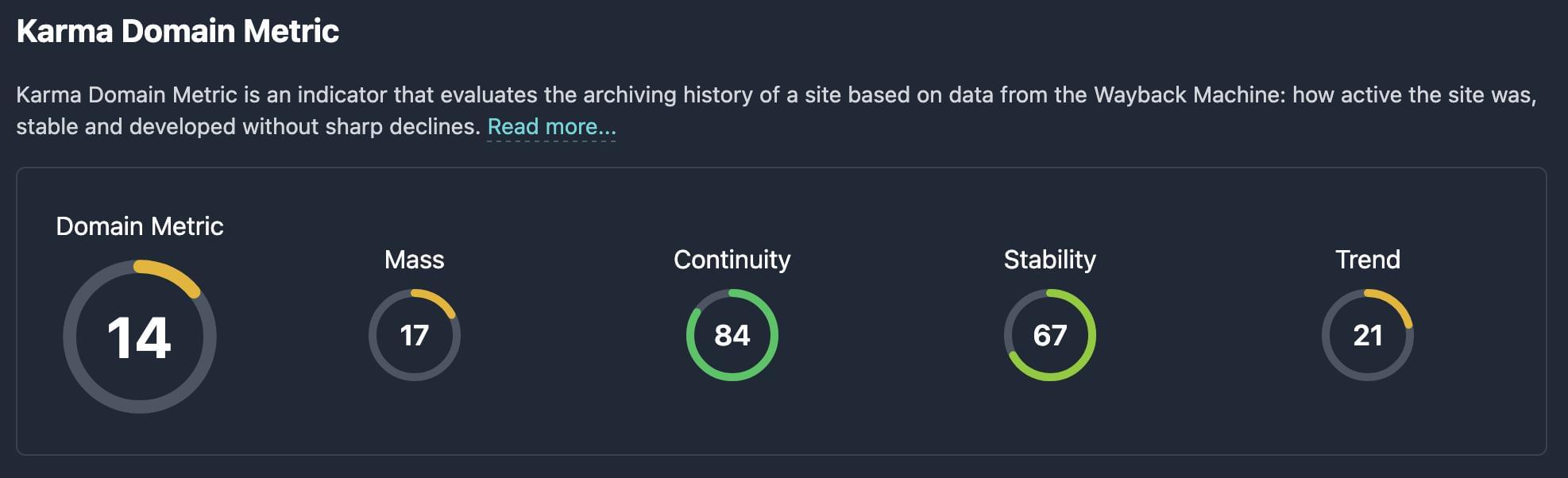
Archive Mass
Archive Mass shows the volume of archived activity — how many times the site was recorded in Wayback Machine during the selected period.
This isn't just a snapshot counter. Mass takes into account:
- recent activity more than old activity,
- the length of the confirmed existence period,
- anomalous spikes,
- aging when there are no new snapshots for a long time.
Archive Continuity
Archive Continuity reflects the regularity of the site's appearance over time.
What matters isn't how many snapshots there were in total, but how evenly the site was present:
- a site that was archived almost every month gets a high score,
- a site with rare and random appearances gets a low score.
Archive Stability
Archive Stability shows how stable the activity was.
It distinguishes:
- smooth, steady development,
- from sharp jumps, drops, and chaotic spikes.
Stability is especially important for identifying networks, temporary projects, and artificially created sites.
Archive Trend
Archive Trend reflects the direction of dynamics:
- whether interest in the site is growing,
- whether it remains at the same level,
- or gradually fades.
This helps distinguish developing projects from those whose activity remained in the past.
How to Read Karma Metric in Practice
A high Karma Metric value means the domain:
- existed for a long time,
- was regularly archived,
- demonstrated stable activity,
- didn't disappear for long periods,
- and overall looked "alive" over time.
But this doesn't mean that the site ranks well or is suitable for any SEO tasks. This is just one layer of analysis.
How to Enable Karma Metric in the Table in Karma.Domains
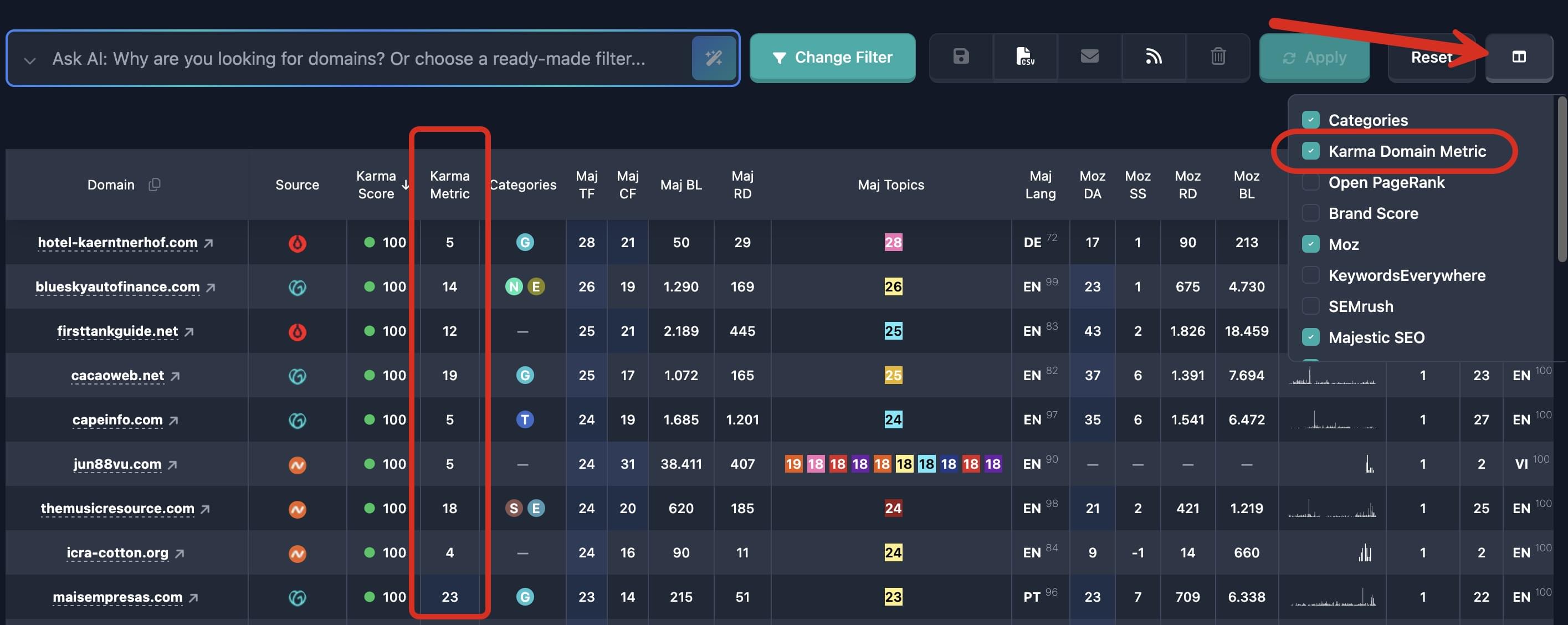
By default, the Karma Domain Metric column in the table is hidden. To display it, you need to enable it in the table settings.
Why Karma Metric is Not a Google Metric
Google doesn't use ready-made external authority indicators. It works with thousands of internal signals, many of which are unavailable from the outside.
Karma Metric is:
- a synthetic model,
- based on open data,
- with conscious assumptions and limitations.
Its goal is to help make a decision, not to predict search positions.
Connection with Other Karma.Domains Metrics
It's important to understand that Karma Metric wasn't designed as a standalone and sole indicator of domain quality.
Karma Metric and Karma Score
Karma Metric works especially well in combination with Karma Score — a historical indicator of domain content quality. While Karma Metric answers the question "how long and consistently has the domain existed and attracted attention", Karma Score answers another, no less important question — "what was the content on this domain".
Their combination allows distinguishing two fundamentally different scenarios:
- a domain existed for a long time but was used for spam, doorways, or low-quality content;
- a domain had a stable history and at the same time published meaningful, thematically coherent content.
Without content analysis, archive history alone can be misleading.
Manipulation Possibility and Approach Limitations
Like any authority metrics — including link-based indicators (DR, AS, TF) — Karma Metric can be manipulated.
During research, we observed domains that:
- were used in traffic manipulation networks,
- had spikes of artificial activity,
- received significant attention from automated systems,
and as a result demonstrated high Karma Metric despite low real quality.
This isn't an algorithm error, but a fundamental property of any behavioral and infrastructural signals: they reflect attention, but not intention.
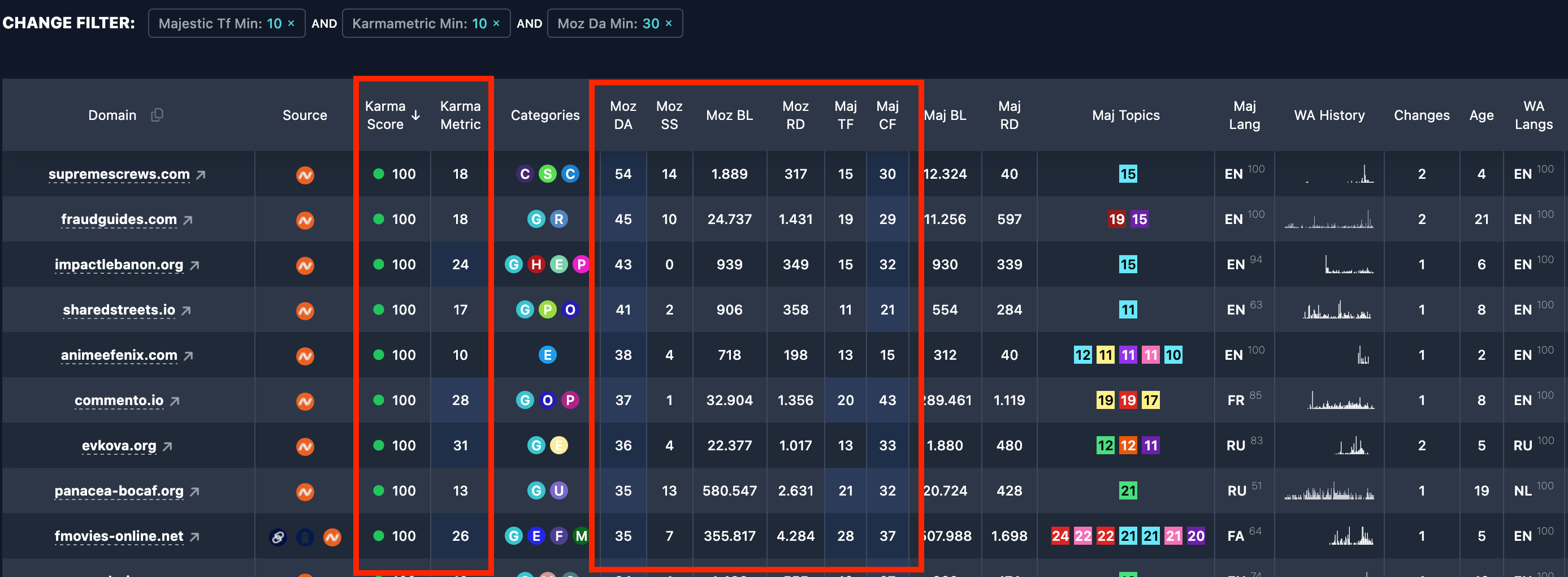
This is why Karma Metric shouldn't be used in isolation. Its weaknesses are effectively compensated by:
- content analysis through Karma Score,
- classic link-based metrics (DR, DA, AS, TF, CF),
- manual domain history verification.
When Karma Metric is Especially Useful
- when analyzing drop domains and domains with history,
- for identifying "dead" sites with manipulated links,
- for finding stable projects without aggressive SEO,
- as a filter before in-depth analysis,
- in combination with Karma Score to evaluate not only history but also content quality.
Limitations and Honest Assumptions
Karma Metric:
- doesn't see content,
- doesn't analyze links,
- doesn't know about penalties,
- doesn't replace manual analysis.
It shows attention history, not "quality in absolute terms." For more accurate analysis, it's recommended to use Karma Metric together with the content quality indicator Karma Score and metrics based on backlinks (DR, DA, AS, TF, CF).
FAQ: Karma Metric — Questions and Answers
1. What Does Karma Metric Actually Measure?
Karma Metric measures historical attention to a domain from web archives, not its positions in Google or link quality. It's an indicator of how long, regularly, and consistently a domain has existed and been updated over time.
2. Can Karma Metric Be Considered a Domain Authority Indicator?
No. It's a synthetic metric, not a Google ranking signal. It's not used directly by search engines and doesn't claim to be. Its task is to provide an independent historical assessment of a domain, especially useful before link analysis.
3. How Does Karma Metric Differ from Ahrefs DR, Moz DA, and Similar Metrics?
Link-based metrics evaluate external signals (backlinks). Karma Metric evaluates the internal history of a domain over time — existence, regularity, stability. These are different axes of analysis, and one doesn't replace the other.
4. Why Can a Domain with Few Snapshots Have a Non-Zero Karma Metric?
Because it's not just the number of snapshots that's considered, but also:
- distribution over time,
- absence of long gaps,
- minimum confirmed lifespan. However, with very little data, the metric is strictly limited from above.
5. Why Can Old but "Quiet" Domains Have Lower Karma Metric Than Expected?
Age alone doesn't equal reliability. If a domain existed formally but was archived rarely, irregularly, or with long pauses, this reduces Mass, Continuity, and Trend.
6. Can Karma Metric Be Manipulated?
Yes. Like any metric based on external signals, Karma Metric can be manipulated, for example:
- through mass content generation,
- through spam sites with high "noise" traffic,
- through artificial page updates.
7. Why Should We Trust Karma Metric at All Then?
Because:
- manipulation requires long time and resources,
- anomalies are clearly visible in dynamics,
- the metric isn't used in isolation, but in combination with Karma Score and link data. This reduces the value of simple manipulation.
8. Why Use Karma Metric Together with Karma Score?
Karma Metric answers the question: "Did the domain have a stable and real history?"
Karma Score answers the question: "What was the quality of content in that history?"
Individually they're useful, but together they provide a much more accurate picture.
9. Can a Domain with High Karma Metric Be Bad for SEO?
Yes. For example:
- an old spam domain,
- a doorway with active history,
- a domain from gray niches.
A high Karma Metric doesn't automatically mean a "good domain" — it means a strong and noticeable history that needs to be interpreted correctly.
10. In What Cases is Karma Metric Especially Useful?
- When analyzing drops and auction domains
- When choosing a domain for a brand or long-term project
- When link data is missing or distorted
- For filtering domains with "empty" or artificial history
Conclusion
Karma Metric isn't an attempt to invent a new PageRank. It's an attempt to add another dimension to SEO analysis — time.
A domain's history, its stability, and lifecycle often say more than a single link authority number. And this is precisely the value of Karma Metric — as an additional, independent lens for analyzing domains together with other metrics.