
TL;DR. Karma Brand Score is a subjective domain brandability metric built around pronounceability, memorability, uniqueness, and appeal. The algorithm is based on the radio test, cognitive psychology, and phonetics, with pronunciation and memorability weighted the most. It doesn’t replace SEO metrics, but it helps startups, investors, and automated naming workflows pick stronger names — and filter out noise like random character strings.
Table of contents
- Table of contents
- Introduction
- What domain brandability means
- The theoretical foundations behind Karma Brand Score
- What Karma Brand Score is made of
- How the final Brand Score is calculated
- Examples
- Why Karma Brand Score matters
- Is there any connection to SEO?
- Finding expired domains in Karma.Domains using Brand Score
- Metric limitations
- FAQ: Karma Brand Score
- 1. What is Karma Brand Score?
- 2. Why measure domain brandability at all?
- 3. Why do pronounceability and memorability matter more than uniqueness?
- 4. Why do domains with numbers and hyphens score low?
- 5. Why is having a real word or root a plus?
- 6. Why do random letter strings sometimes get a medium score?
- 7. What counts as a good Karma Brand Score?
- 8. Does the TLD affect the score?
- 9. Is Karma Brand Score related to SEO?
- 10. Can I use Karma Brand Score for naming?
- Conclusion
Introduction
Choosing a domain name is still largely subjective.
“Sounds good,” “I like it,” “looks like a brand” — that’s how decisions get made, and those decisions can shape a product, startup, or company for years.
At Karma.Domains, we took a different approach. We asked a simple question: can we measure domain brandability in a way that’s objective, scalable, and repeatable?
That’s how Karma Brand Score was born — a metric that evaluates the quality of a domain name as a potential brand.
In this article, I’ll cover:
- what “domain brandability” actually means,
- which research and principles our algorithm is based on,
- what components make up Karma Brand Score,
- how the score is calculated,
- and why this metric matters in practice — including from an SEO perspective.
What domain brandability means
A brandable domain is not just a short or rare name.
It’s a name that:
- is easy to pronounce,
- is easy to remember,
- doesn’t create confusion when spoken out loud,
- doesn’t look like a random string of characters,
- can scale with the product,
- and doesn’t lock the business into a niche or location.
One important nuance: brandability isn’t the same thing as uniqueness.
A random string like xqvplk.com can be “unique,” but it’s not a brand.
The theoretical foundations behind Karma Brand Score
We didn’t invent this algorithm out of thin air. It’s grounded in well-known naming principles, linguistics, and cognitive psychology.
The radio test
One of the core concepts in naming is the radio test.
If you say the name on a phone call or in a podcast and the other person can’t write it down correctly, it’s a weak name.
Numbers, hyphens, unusual spellings, and rare letter patterns all reduce how “radio-friendly” a name is.
The psychology of word memorability
Research in cognitive psychology consistently shows that:
- shorter words are easier to remember than longer ones,
- 1-3 syllable words are processed more easily,
- familiar morphemes and real roots improve recall,
- visual simplicity lowers cognitive load.
That’s why domains with a clear structure almost always beat names that feel complex or overloaded.
Phonetics and linguistics
Words aren’t just letters — they’re phonemes.
Some sound combinations are natural in English, while others are extremely rare.
Domains with “heavy” consonant clusters tend to feel awkward and are harder to pronounce.
In Karma Brand Score, we use:
- phonetic dictionaries (CMU Pronouncing Dictionary),
- phoneme n-gram likelihoods,
- vowel-to-consonant balance,
- syllable structure.
Brandability vs descriptiveness
Another key principle: brand ≠ description.
Domains like bestcheapwebhosting.com can be clear, but they:
- don’t scale well,
- don’t differentiate well,
- rarely become strong brands.
What Karma Brand Score is made of
Karma Brand Score is built on four axes, each measuring a different aspect of brandability.
1. Pronounceability
We analyze:
- the phonetic structure of the name,
- sound-combination probabilities,
- hard consonant clusters,
- numbers, hyphens, leetspeak substitutions,
- ambiguous spellings (radio ambiguity).
If a domain is hard to say, it can’t be a strong brand.
2. Memorability
This axis includes:
- name length,
- syllable count,
- visual readability,
- segmentation into real words,
- frequency of dictionary roots.
Domains with real roots (like studio, nova, zoom) are typically more memorable than abstract strings.
3. Uniqueness
With one important caveat.
We penalize fake uniqueness, such as:
- random letter soup,
- no vowels,
- no meaningful structure.
A unique brand isn’t noise — it’s a recognizable shape.
4. Appeal
This is the most “human” axis, but it’s still formalized:
- positive vs negative morphemes,
- pleasant sound (euphony),
- alliteration,
- visual cleanliness,
- avoiding unpleasant associations.
How the final Brand Score is calculated
We don’t just add the axes together.
The algorithm follows a brand viability principle:
if a domain is hard to pronounce or hard to remember, it can’t earn a high final score — no matter how unique it is.
Pronounceability and memorability are weighted higher than the other parameters.
That’s intentional, and it reflects how real brand markets work.
Examples
Why is studio.com stronger than sroupqk.com?
- studio is a real word,
- it’s easy to pronounce,
- easy to remember,
- doesn’t need explanation,
- and it scales.
Even if the random string is “more unique” on paper, it loses as a brand.
Why Karma Brand Score matters
For startups and SaaS
- choosing a name with growth potential,
- reducing marketing costs,
- earning higher trust early on.
For domain investors
- filtering for liquid, brandable domains,
- removing junk candidates,
- doing large-scale analysis without relying on personal taste.
For automated naming
- generating and ranking candidates,
- A/B testing name options,
- plugging into AI naming workflows.
Is there any connection to SEO?
Karma Brand Score is not an SEO metric.
But brandability can influence SEO indirectly:
- higher CTR,
- more branded searches,
- stronger user trust,
- easier link building.
A strong brand makes long-term SEO easier, even if it doesn’t directly change rankings.
Finding expired domains in Karma.Domains using Brand Score
In Karma.Domains (our expired domain search service), you can view Brand Score and its components in the domain report, show it in tables, and use it as a filter when searching.
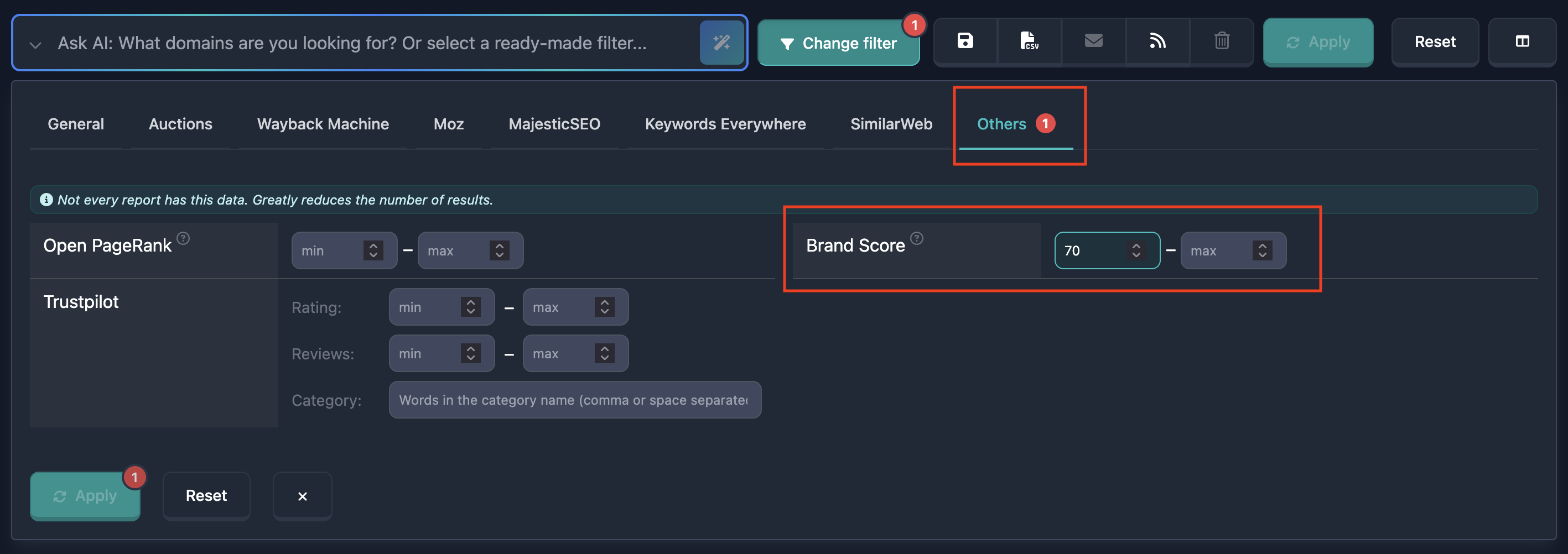
To filter the domain database by Brand Score in Karma.Domains, use the "Brand Score" filter in the "Others" section.
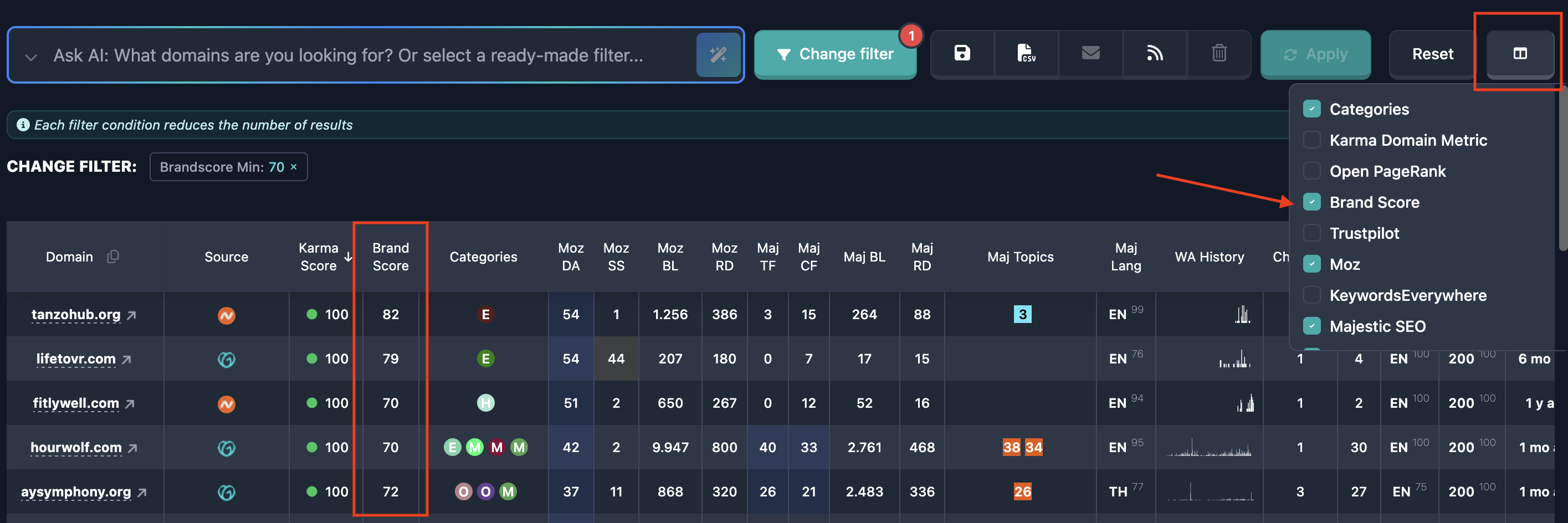
To see Brand Score in the table, you need to enable it in the column settings. By default, the column is hidden. Once enabled, you can sort domains in the table by Brand Score.
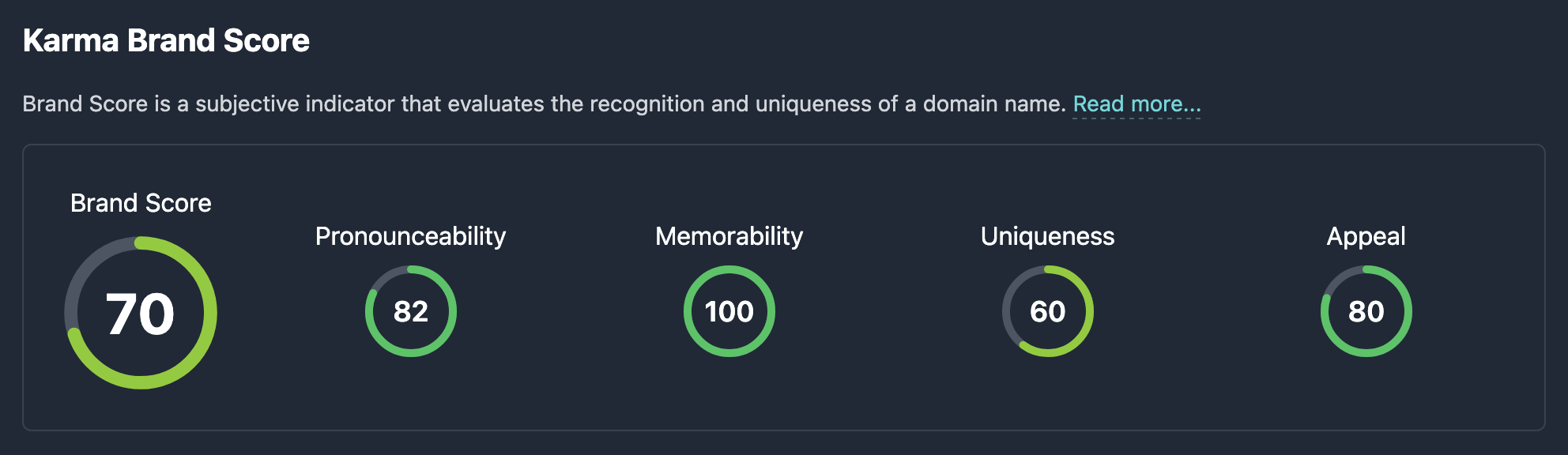
In the domain report itself, you’ll also find detailed Brand Score breakdowns — Pronounceability, Memorability, Uniqueness, and Appeal — inside the Karma.Domains section alongside our other metrics (Karma Score and Karma Metric).
Metric limitations
It’s important to understand:
- Brand Score doesn’t predict business success,
- cultural and language nuances matter,
- the metric is a filter — not a replacement for thinking.
FAQ: Karma Brand Score
1. What is Karma Brand Score?
It’s a numeric estimate of how suitable a domain name is as a brand based on pronounceability, memorability, uniqueness, and overall appeal.
2. Why measure domain brandability at all?
Because choosing names based on taste and intuition doesn’t scale, and a formal metric helps you quickly filter weak options and reduce the risk of a bad pick.
3. Why do pronounceability and memorability matter more than uniqueness?
Because a brand needs to be easy to say and easy to remember. Uniqueness without readability and structure rarely creates real value.
4. Why do domains with numbers and hyphens score low?
They usually fail the radio test, require extra explanation when spoken, and are more likely to be typed incorrectly — which makes them weaker brands on average.
5. Why is having a real word or root a plus?
Familiar words and morphemes are recognized faster by the brain, are easier to remember, and reduce cognitive load — which strengthens the brand.
6. Why do random letter strings sometimes get a medium score?
Because they can be short and technically unique, but they’re still limited by weak pronounceability and memorability — and they rarely become strong brands.
7. What counts as a good Karma Brand Score?
As a rough guideline: 80+ is a strong brandable domain, 65-80 is a solid workable option, and below 65 usually means noticeable limitations.
8. Does the TLD affect the score?
In most cases we score the name itself, but longer, meaningful TLDs like .design or .studio can be treated as part of the brand in some contexts.
9. Is Karma Brand Score related to SEO?
It’s not an SEO metric, but a strong brand can indirectly improve CTR, user trust, and branded search demand, which helps SEO over time.
10. Can I use Karma Brand Score for naming?
Yes. It works well for ranking large batches of name ideas, but the final decision should always consider your product strategy and context.
Conclusion
Brandability isn’t magic, and it isn’t just “taste.”
It’s a set of linguistic, cognitive, and market factors you can analyze and measure.
Karma Brand Score is our way to make that process more objective, scalable, and useful for real decisions.