
Karma Score is a metric of domain content history quality. It does not measure authority, link weight, or search engine trust. Its purpose is different and more specific: to understand what content the domain was filled with throughout its lifetime and what signals this content sent.
Table of Contents
- Table of Contents
- What is Karma Score
- What Problem Does Karma Score Solve
- Data Source
- Basic Algorithm Principle
- Positive Flags (Good Content Signals)
- Negative Flags (Bad Content Signals)
- Temporal Logic: Why Sequence Matters
- Karma Score — Not About Scale, But About Quality
- Relationship with Karma Metric
- Can Karma Score Be Manipulated
- Why Karma Score Is Not a Google Factor
- Who Especially Benefits from Karma Score
- FAQ: Karma Score
- 1. What is Karma Score in simple terms?
- 2. What data is Karma Score based on?
- 3. What are "flags" in Karma Score?
- 4. Why can a domain with high DR or AS have a low Karma Score?
- 5. Can Karma Score be high for a domain without links?
- 6. Can Karma Score be manipulated?
- 7. Does Karma Score consider the current site content?
- 8. How does Karma Score differ from Karma Metric?
- 9. Why is history important, not the current site?
- 10. For what tasks is Karma Score especially useful?
- Conclusion
What is Karma Score
Karma Score is a metric of domain content history quality.
It does not measure authority, link weight, or search engine trust. Its purpose is different and more specific:
to understand what content the domain was filled with throughout its lifetime and what signals this content sent.
The foundation of Karma Score is a simple but fundamentally important approach:
domain history is a sequence of signals, not a set of separate snapshots
We are not trying to guess Google's algorithms. We systematically classify the domain's past into good and bad patterns.
What Problem Does Karma Score Solve
Most metrics look at a domain "here and now":
- how many links
- what DR / DA / TF / AS
- whether there is traffic
But in reality, when working with drops, auctions, and recovered domains, something else is more important:
- what the site was before
- how often and sharply the content changed
- whether there were periods of spam, doorways, junk
- how consistently the project developed
Karma Score was created specifically for this layer of analysis.
Data Source
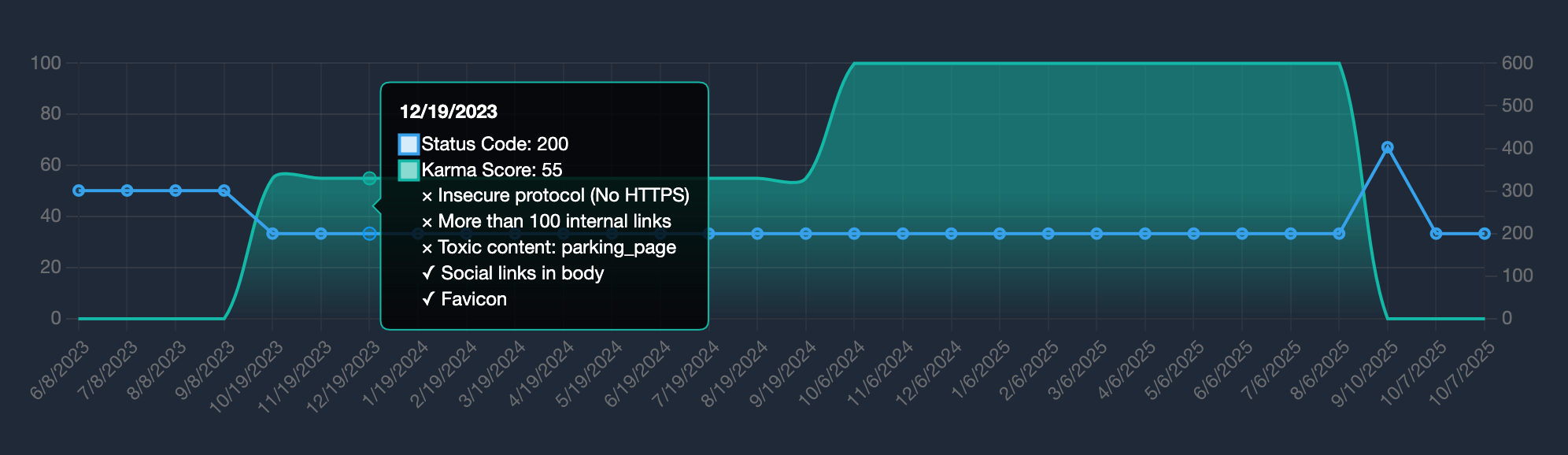
The only mandatory data source for Karma Score is Wayback Machine.
The algorithm analyzes:
- archived page versions
- text content
- repeating patterns
- temporal sequence of changes
Important: we do not analyze a single snapshot. We analyze a chain of domain states.
Basic Algorithm Principle
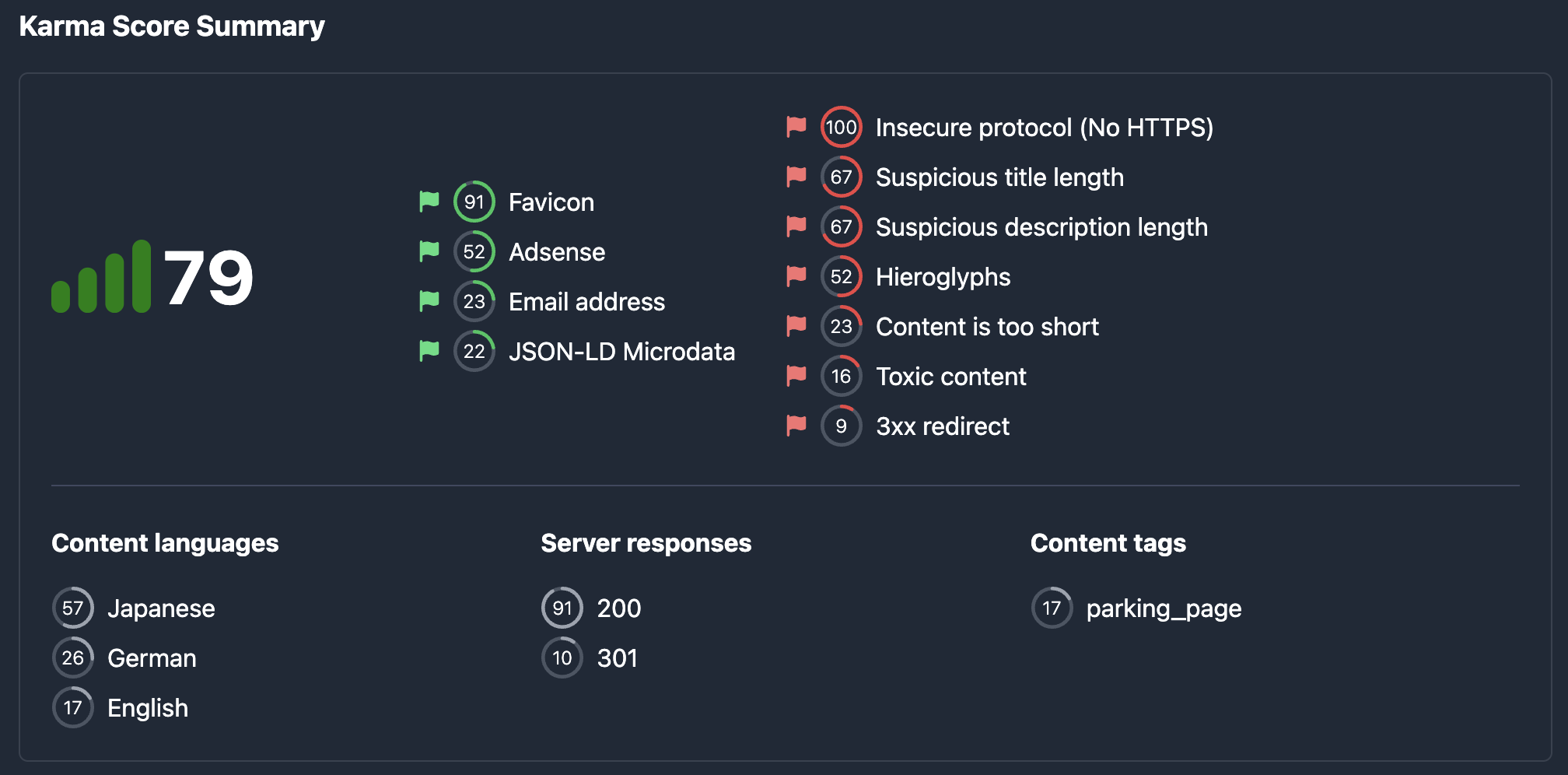
The Karma Score algorithm works as a flag system.
Each archived period of the domain is checked for:
- positive signals (good flags)
- negative signals (bad flags)
The final score is not a sum of "points", but the result of accumulated flag balance over time. Displayed as a value ranging from 0 to 100, where 0 is the lowest score and 100 is the highest.
Positive Flags (Good Content Signals)
Positive signals include, for example:
- meaningful text content
- thematic integrity
- readable page structure
- absence of SEO templates
- stable site type over time
If a domain published normal content for years without sharp distortions, it accumulates positive history.
Negative Flags (Bad Content Signals)
Negative flags are not "errors", but risk patterns. For example:
- doorways
- auto-generated text
- SEO spam
- parasite pages
- sharp topic changes
- empty or placeholder sites
Important: one bad period does not kill a domain.
But repeated or prolonged negative patterns significantly lower Karma Score.
Temporal Logic: Why Sequence Matters
Karma Score is sensitive to:
- duration of periods
- order of events
- pattern repetition
Examples:
- brief spam period 10 years ago — weak negative
- alternating normal content and spam — strong negative
- consistent development of one topic — strong positive
This is a fundamental difference from static metrics.
Karma Score — Not About Scale, But About Quality
It is important not to confuse Karma Score with popularity metrics.
- a small but honest site can have a high Karma Score
- a large domain with spam history — low
Here volumes are not important, the nature of content is.
Relationship with Karma Metric
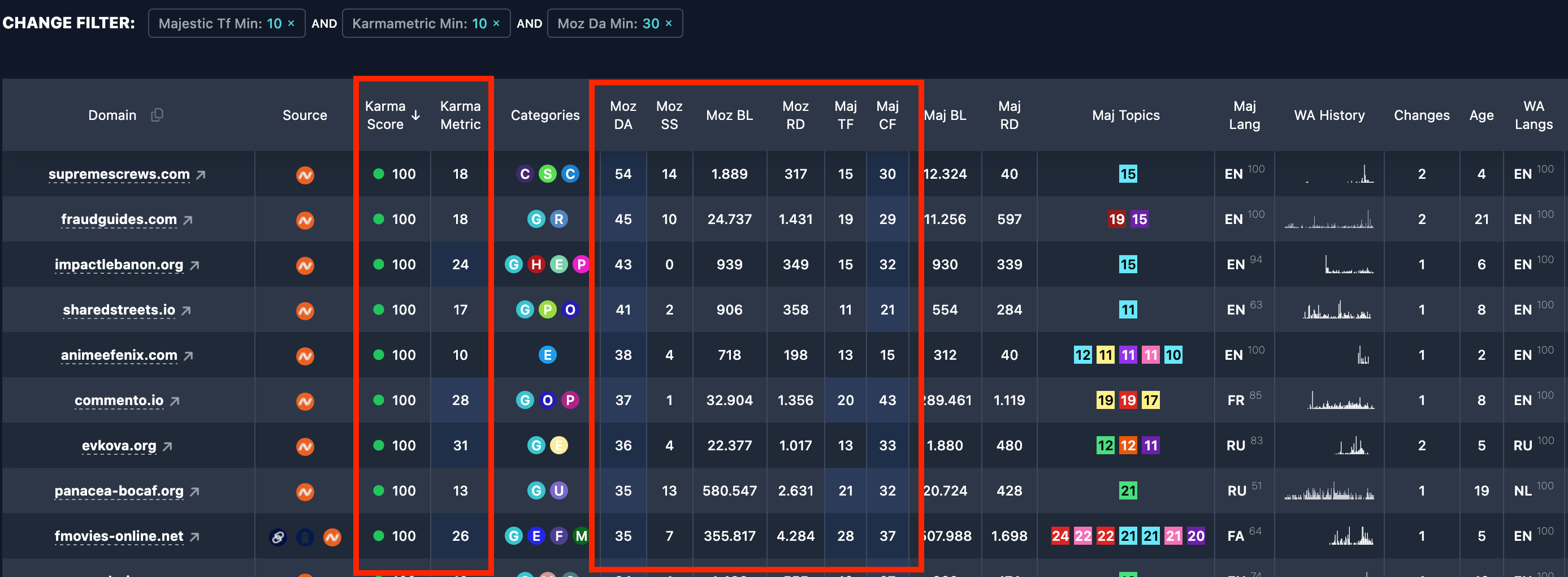
Karma Metric and Karma Score solve different tasks:
- Karma Metric — how noticeable and active the domain was over time
- Karma Score — how quality this path was
Intuitively:
- Karma Metric answers for "volume"
- Karma Score — for "meaning"
This is why they complement each other.
Can Karma Score Be Manipulated
Theoretically — yes.
For example:
- carefully maintained doorway
- long-lived but artificial project
But in practice, such domains:
- reveal themselves with repeating templates
- have weak connection with Karma Metric
- are easily identified in joint analysis
Karma Score is not designed as a single filter. It works in a system of signals.
Why Karma Score Is Not a Google Factor
Karma Score is not a Google ranking factor.
It is:
- a research metric
- a model for interpreting history
- a decision-making tool
We do not know Google's internal weights and do not try to reproduce them.
But we know that domain history matters — and we make it measurable.
Who Especially Benefits from Karma Score
- SEO specialists
- drop domain owners
- PBN builders
- domain investors
- everyone who works with domains with history
If you buy a domain "from hand" or "from auction", Karma Score helps see what is not visible in links.

FAQ: Karma Score
1. What is Karma Score in simple terms?
Karma Score is a metric that shows how "clean" or "problematic" a domain's content history has been. It analyzes not links or the current site, but what was hosted on the domain before and what types of content appeared there.
2. What data is Karma Score based on?
The metric is based on:
- archived site versions (Wayback Machine),
- automatic analysis of content from these versions,
- a flag system that marks good and bad content signs.
Each archived period is evaluated separately, then a general picture is assembled.
3. What are "flags" in Karma Score?
Flags are signals that characterize content type:
- good (for example: informational site, branded content, normal structure),
- bad (doorways, SEO spam, auto-generated content, casino, pharma, etc.).
Karma Score does not look at one snapshot — it considers repetition and duration of these flags over time.
4. Why can a domain with high DR or AS have a low Karma Score?
Because:
- link metrics evaluate link profile,
- Karma Score evaluates content history.
A domain could:
- be a doorway or spam site for a long time,
- then receive links or traffic,
- but its content history remained toxic.
For Google, such domains are often problematic, even with strong links.
5. Can Karma Score be high for a domain without links?
Yes. If a domain:
- was used for normal content for a long time,
- did not have toxic phases,
- did not change topic to spam,
then Karma Score will be high, even without strong links.
This is normal and expected.
6. Can Karma Score be manipulated?
Theoretically — yes, but it is difficult and expensive:
- need to maintain "clean" content for a long time,
- cannot sharply change topic,
- cannot do mass doorways or auto-generation.
In addition, Karma Score is used together with other metrics, and manipulation attempts are usually well visible in combination.
7. Does Karma Score consider the current site content?
Not directly. It looks at history, not the current version.
This is done specifically so that:
- one cannot "change shoes" in one month,
- temporary redesign or placeholder does not break the assessment,
- focus remains on long-term domain behavior.
8. How does Karma Score differ from Karma Metric?
Briefly:
- Karma Score — what was on the domain (content quality).
- Karma Metric — how actively and long the domain was used (archive activity).
They solve different tasks, but together give a much more accurate picture.
9. Why is history important, not the current site?
Because:
- Google evaluates sites over time,
- past sanctions and toxic phases do not disappear instantly,
- many drop domains "look clean" but have a bad past.
Karma Score helps see what is not visible on the current site version.
10. For what tasks is Karma Score especially useful?
The metric is especially useful for:
- buying drop domains,
- building PBNs,
- link building,
- assessing redirect risks,
- filtering domains with "dirty" history.
This is not a replacement for SEO metrics, but a quality filter of the past.
Conclusion
Karma Score is not authority and not search engine trust.
It is an assessment of past domain behavior through the lens of content.
And very often, it is this past that determines what can be done with the domain next — and what definitely should not be done.