
Moz Domain Authority (DA) is a 0 to 100 score that predicts how well a site might rank, based mostly on its backlinks. Google doesn't use it, but the work that raises DA usually helps real rankings as well. If you're a site owner or SEO who needs a higher DA for clients or link deals, this guide gives you ten practical steps, the mistakes that waste time, and a way to track DA next to DR and Karma Domain Metric in our free Domain Authority Checker.
Table of Contents
- Table of Contents
- Introduction
- What is Moz Domain Authority?
- How Moz calculates DA
- 10 steps to increase Moz Domain Authority
- 1. Build a strong backlink profile
- 2. Fix on-page SEO
- 3. Publish content people link to
- 4. Improve technical SEO
- 5. Strengthen internal linking
- 6. Audit and clean toxic backlinks
- 7. Improve user experience
- 8. Use social channels for reach, not magic buttons
- 9. Stay consistent
- 10. Measure progress properly
- DA vs DR vs Karma Domain Metric
- Common mistakes
- FAQ
- Conclusion
Introduction
Moz Domain Authority (DA) shows up in every SEO pitch deck. Site owners watch the number like a stock ticker. Competitors compare scores over coffee.
DA is useful for benchmarking. It is also easy to misuse: treated as a Google metric, bought with shady links, or confused with Ahrefs DR, which uses a different model and crawl.
This post is the practical version: what Moz DA actually is, how Moz calculates it, ten things that move the score in real projects, what to avoid, and how to track progress without fooling yourself.
What is Moz Domain Authority?
Moz Domain Authority is a 0 to 100 score that estimates how well a domain might rank in search, based largely on its backlink profile.
Inputs include linking root domains, total backlinks, spam signals, and other link-graph data Moz collects. Wikipedia and major publishers sit above 90. New sites often land below 20. The scale is logarithmic: jumping from 10 to 30 is far easier than 70 to 80.
Three facts that prevent a lot of wasted budget:
- DA is comparative. Your score can drop if competitors gain links even when you do nothing.
- DA is not a Google ranking factor. It is Moz's model. Helpful for comparison, not a position guarantee.
- DR (Ahrefs), AS (Semrush), and TF (Majestic) measure similar ideas with different crawls. Do not expect them to match DA digit for digit.
Higher DA usually correlates with stronger link profiles and more ranking potential. Correlation, not causation.
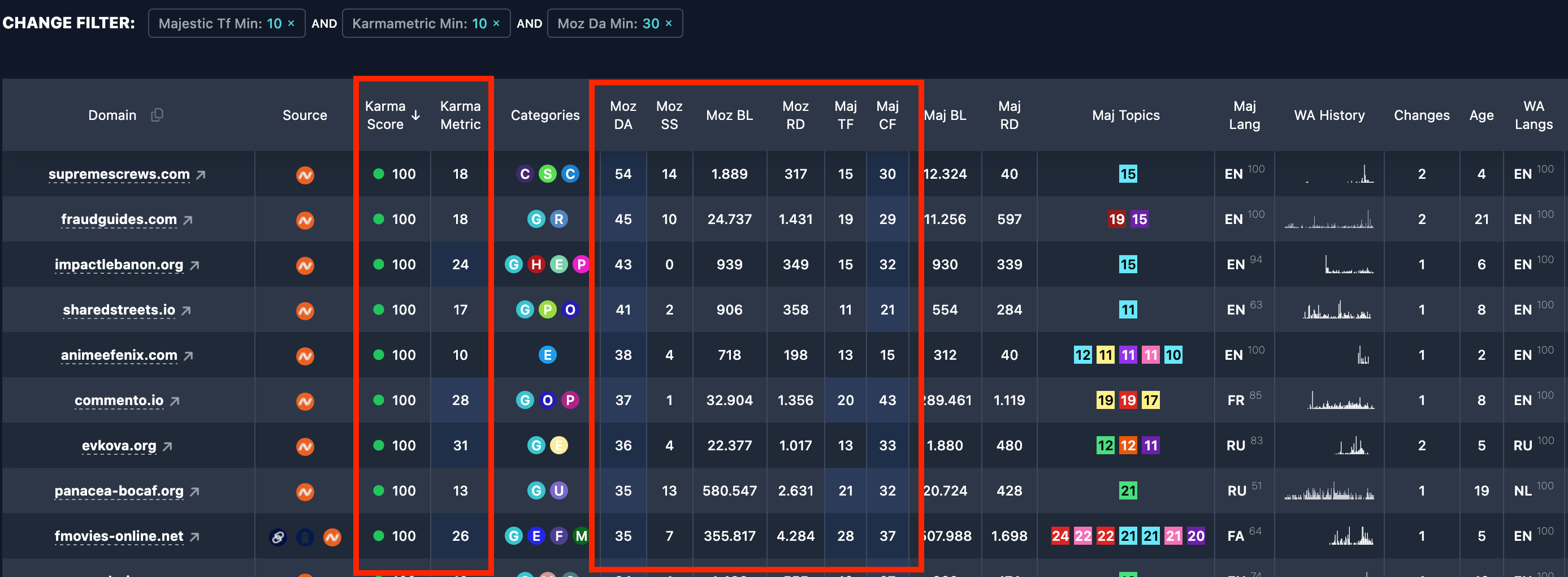
If you screen expired or aged domains, DA is one line on the spreadsheet, not the whole story. A domain can show high DA from old links while the site has been dead for years. Karma Domain Metric adds archive history; Karma Score flags toxic content in that history. Our Domain Authority Checker returns DA, DR, UR, spam score, and KDM for up to 10 domains at once.
How Moz calculates DA
Moz uses machine learning trained on link data to predict ranking potential relative to other sites in its index.
Signals that matter most:
- Quality and quantity of inbound links
- Diversity of referring domains (many sites beat many links from one site)
- MozRank and MozTrust (Moz's internal link metrics)
- Spam score (lower is better)
- Overall link graph shape around your domain
Because the score is relative and logarithmic, patience is part of the math. A ten-point gain at DA 25 is a different project than at DA 65.
10 steps to increase Moz Domain Authority
1. Build a strong backlink profile
Links remain the main lever for DA. Earn them from relevant, trusted sites in your niche. Skip spam directories, link farms, and irrelevant guest posts sold in bulk.
Tactics that still work when done honestly:
- Guest posts on sites your audience actually reads
- Linkable assets: research, tools, guides people cite by default
- Broken link building on resource pages in your space
- Relationships with editors and creators who mention you naturally
A few editorial links from strong domains beat hundreds of weak ones. DA reflects that.
2. Fix on-page SEO
DA is link-heavy, but pages need to be crawlable and coherent for those links to compound.
Worth doing:
- Title tags and meta descriptions that match the query without keyword stuffing
- Logical heading structure (H1, H2, H3)
- Short descriptive URLs
- Image alt text and compression
- Internal links between related pages
On-page work supports rankings directly. Cleaner sites also attract links more easily.
3. Publish content people link to
Thin posts rarely move DA. Pages that earn citations tend to be thorough, useful, and specific.
Longer articles often collect more links, but length is not the goal. A tight 800-word answer beats a padded 3,000-word recap. Update old posts when facts change. Mix formats (guides, case studies, data posts) if your audience uses them.
Content does not replace link outreach. It gives outreach something worth pointing at.
4. Improve technical SEO
Crawlers and users both punish slow, broken sites.
Checklist:
- Core Web Vitals and general page speed
- Mobile layout that works on real phones
- XML sitemap submitted and current
- HTTPS everywhere
- 404s fixed or redirected so equity does not leak
Technical health will not spike DA alone. It stops you from wasting whatever links you already have.
5. Strengthen internal linking
Internal links pass equity inside your domain and help Moz (and Google) see topic relationships.
Link new posts to relevant older pages. Link pillar content down to cluster articles and back up. Do not stuff links; each one should help the reader.
If you bought an aged domain, plan internal architecture before you publish fifty unrelated pages. Equity disperses fast when structure is flat.
6. Audit and clean toxic backlinks
Spammy inbound links can drag spam score up and hurt trust signals.
Run backlink audits in Moz, Ahrefs, or similar tools. Request removal when you can. Use Google's Disavow Tool only for clear junk you cannot remove (disavow is a last resort, not a monthly habit).
When evaluating drops on Karma.Domains, high DA plus high spam score is a red flag. Check anchors and referring domains before you bid.
7. Improve user experience
Dwell time, bounce rate, and CTR are not DA inputs. Google sees them. Better engagement often follows better rankings, which can attract more links over time.
Readable typography, clear navigation, and fast pages beat aggressive popups. The goal is simple: people find what they came for and stay long enough to trust you.
8. Use social channels for reach, not magic buttons
Social shares do not feed Moz DA directly. They put content in front of people who might link later.
Share work that deserves attention. Reply in communities where your niche actually talks. A viral post sometimes earns editorial links; most of the time it just earns traffic. Both help, only one moves DA reliably.
9. Stay consistent
DA rarely jumps in a week. Publish on a schedule you can keep. Monitor links monthly. Fix technical regressions before they pile up.
Starting from DA 15 on a young site? Six months of steady work might add ten points. Starting from DA 55? Expect slower movement. Competition at the top of the log curve is brutal.
10. Measure progress properly
Track DA in Moz over time. Cross-check with Google Search Console (impressions, clicks) and Analytics (organic sessions, landing pages).
Set realistic targets: DA +5 in six months on a growing site is a solid win. DA +30 in six months is fantasy unless something unusual happened.
For bulk comparison (your site vs competitors, or a shortlist of drops), use our free Domain Authority Checker. Same run gives DR and DA side by side so you are not optimizing for one vendor's number in a vacuum.
DA vs DR vs Karma Domain Metric
| Metric | Source | What it measures |
|---|---|---|
| DA | Moz | Domain-wide link strength (predicted) |
| DR | Ahrefs | Domain-wide link strength (different crawl) |
| KDM | Karma.Domains | Wayback archive history (age, continuity, trend) |
DA and DR answer: "How strong are this domain's backlinks?"
KDM answers: "Did this domain exist consistently over time, and is interest fading or growing?"
A drop domain can show DA 45 from legacy links while KDM shows a dead site. Karma Score adds whether the history was spam. Use all three layers before you buy; use DA and rankings data when you grow a site you already own.


Common mistakes
Buying links instead of earning them. Short DA bumps, long cleanup.
Ignoring speed and mobile. Links cannot save a site Google struggles to crawl or users refuse to load.
Publishing thin content at volume. DA follows links; thin content does not earn them.
Relying on the same few referring domains. Diversity matters.
Letting old posts rot. Refresh or redirect; do not leave broken assets linked from high-equity pages.
Chasing DA while ignoring rankings and traffic. The score is a compass, not the destination.
Treating DA on an expired domain as proof of quality. Check Wayback, spam score, and topical fit. See how to find and buy aged domains for the full workflow.
FAQ
Does increasing Moz DA improve Google rankings?
Not directly. DA is Moz's estimate. The backlinks and content quality that raise DA are what search engines tend to reward.
How long does it take to increase DA?
Usually months, not days. Link acquisition speed and your starting score dominate the timeline.
What is a good DA score?
Depends on niche. Compare against sites that actually rank for your targets. A DA of 40 can be strong in a local market and weak in national SaaS.
Is DA the same as DR?
No. Different companies, crawls, and formulas. Use both for direction; do not expect parity.
Can I raise DA without link building?
On-page, technical, and internal link work help rankings and set you up for links. Moz DA itself is built from external link data. To move DA, you need external links eventually.
Why did my DA drop without site changes?
Competitors gained links, Moz recrawled and rescored, or you lost good links naturally. DA is relative.
Conclusion
Moz Domain Authority is a useful benchmark for link strength. It is not a Google score, not a shortcut, and not interchangeable with DR or traffic charts.
Raise it the boring way: earn relevant backlinks, publish pages worth citing, keep the site fast and crawlable, link internally with intent, clean toxic links, and measure for months.
Our Domain Authority Checker baselines DA, DR, UR, and KDM. For domain shopping, add Karma Score and filters on Karma.Domains. For growing a site you own, watch DA alongside rankings and organic traffic. When those move together, the number on the dashboard means something.