
Page Authority (PA) is a third-party score for a single URL, built mostly from its backlinks. Google doesn't use it directly, though the work that raises PA is the same work that moves a page up in search. This guide is for SEOs and content owners who want one particular page to outrank a competitor's. It covers ten tactics and the mistakes worth skipping, then shows how to set a baseline and track progress with UR, PA, and Karma Domain Metric in our free Domain Authority Checker.
Table of Contents
- Table of Contents
- Introduction
- What is page authority?
- Page authority vs domain authority
- What affects page authority
- 10 ways to increase page authority
- 1. Publish content worth linking to
- 2. Build backlinks on purpose
- 3. Fix Core Web Vitals and technical basics
- 4. Fix internal linking
- 5. Match search intent
- 6. Build topical depth
- 7. Social and brand mentions
- 8. E-E-A-T in practice
- 9. Featured snippets and rich results
- 10. Watch algorithm updates without obsessing over them
- How to measure progress
- Common mistakes
- FAQ
- Conclusion
Introduction
In SEO threads, "page authority" usually shows up right after: "Why does their page rank and mine doesn't?"
PA helps answer that, up to a point. It is also mixed up constantly with domain authority, mistaken for a Google score, or chased with tactics that stop working the month after you deploy them.
What follows is the practical version: what page authority measures, what feeds it, ten things that work in practice, and how to tell if any of it is working.
What is page authority?
Page authority is a 0 to 100 style score that guesses how well a specific URL might rank. The guess is based mainly on backlinks pointing at that URL.
Moz calls it Page Authority (PA). Ahrefs has URL Rating (UR). Other tools have their own page-level link scores. Different names, same idea.
Three distinctions that save people a lot of wasted outreach:
- Page-level, not site-level. Your domain can look strong while a new article has almost no equity. The reverse happens too.
- Third-party estimate, not a Google metric. Handy for comparing URLs. Not a ranking signal on its own.
- Built from links first. Content, UX, and technical SEO affect rankings directly. PA and UR mostly reflect link data.
Search engines use a large mix of signals: link quality, relevance, page speed, whether the content matches the query. E-E-A-T (Experience, Expertise, Authoritativeness, Trustworthiness) shows up when a page clearly comes from someone who knows the subject and cites real sources. It is not a one-time badge you add in a footer.
Higher PA usually means higher ranking potential for that URL. Potential, not promise.
Page authority vs domain authority
People confuse these two constantly, then wonder why their link building feels pointless.
| Page authority | Domain authority | |
|---|---|---|
| Scope | One URL | Entire domain |
| Typical tools | Moz PA, Ahrefs UR | Moz DA, Ahrefs DR |
| Best for | Landing pages, pillar articles, product pages | Comparing sites, screening expired domains |
Say example.com has DA 55 after years of site-wide links. A fresh post at example.com/guides/seo-basics might still sit at PA 12 until it earns its own links.
If you buy expired or aged domains (a common workflow on Karma.Domains), domain metrics like DR and DA tell one story. Page metrics like UR and PA tell another. A drop can show a flashy DR while the homepage, the page you would actually build on, has almost nothing left.
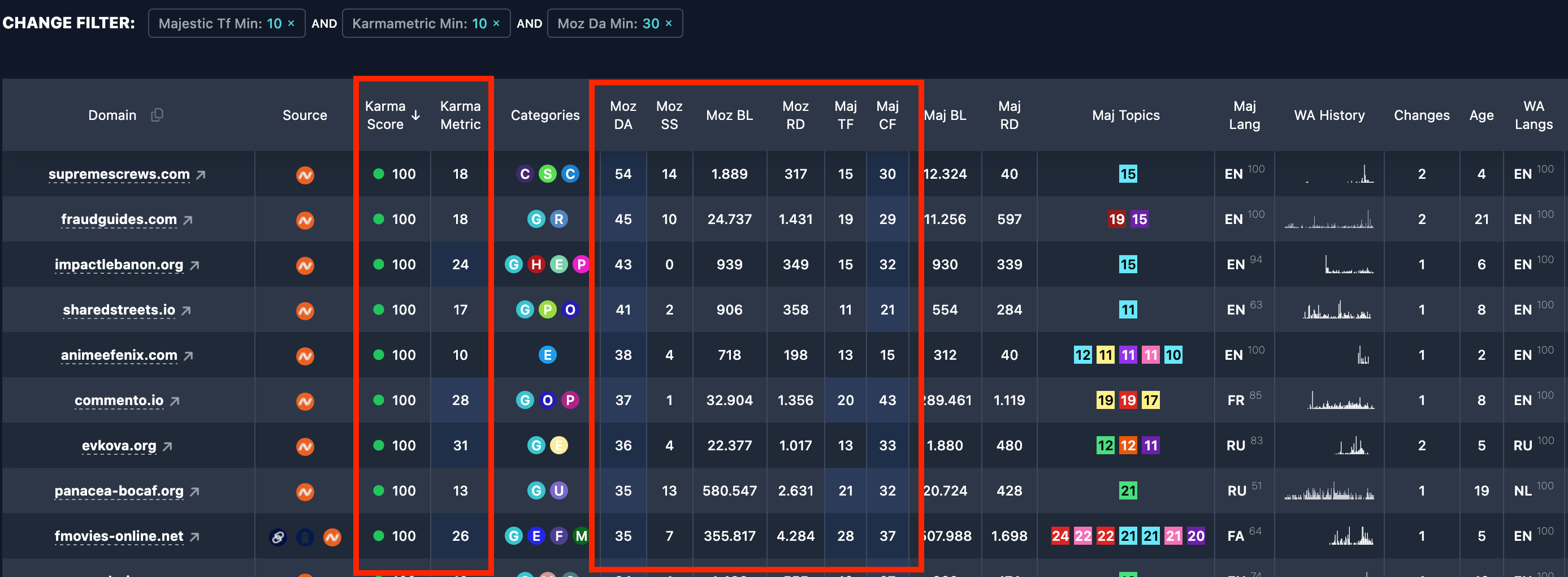
Our free Domain Authority Checker returns DR, DA, and UR for the homepage (the closest bulk proxy for page authority) for up to 10 domains, no signup. For history beyond links, add Karma Domain Metric and Karma Score.
What affects page authority
Backlink profile
Quality, relevance, and variety of links to this page, not just the domain. A few editorial links from trusted sites in your niche beat a pile of directory listings.
Content quality
Original, thorough content that matches what the searcher wanted. Depth and accuracy matter. So does answering the full question instead of skimming the surface.
User experience signals
Dwell time, bounce rate, and engagement do not feed PA directly; third-party tools cannot see them. Google can. Pages that satisfy searchers tend to keep ranking, and ranked pages pick up links over time.
Technical SEO
Speed, mobile usability, HTTPS, clean indexation, structured data. A page cannot accumulate authority if crawlers struggle to reach it or users bail in two seconds.
10 ways to increase page authority
1. Publish content worth linking to
"Content is king" is old. The bar for what counts as good content is not.
Pages that earn links tend to:
- cover the topic properly, including angles competitors skip
- include original data, research, or a point of view
- cite sources and show the author knows the subject
- get updated when the facts change
- read cleanly: headings, lists, visuals only where they help
Surface-level posts rarely attract links. Reference pages do. Search engines notice the difference, and so do readers who stay longer.
2. Build backlinks on purpose
Backlinks remain the main input for PA and UR. Volume is the wrong game.
Linkable assets work: original research, a guide that becomes the default reference, a small free tool. Targeted outreach to relevant sites beats mass cold email. Expert roundups help when you actually add insight. Unlinked mention reclamation is slow but real: find citations without links, ask politely. Relationships with people who publish in your space compound over time.
Paid link schemes, PBNs, and irrelevant guest posts at scale still get caught. A short PA bump from shady links rarely survives the next update.
One detail people skip: point links at the URL you want to rank, not only the homepage.
3. Fix Core Web Vitals and technical basics
Technical SEO does not replace link building. It stops you from leaking whatever equity you already have.
Worth checking: Core Web Vitals (LCP, INP, CLS), schema where it fits the content type, responsive layout, load time on a real phone and a slow connection, crawl errors, broken links, redirect chains, accidental noindex.
Slow or broken pages make everything else harder.
4. Fix internal linking
You already own this equity. Many sites barely use it.
Link from strong pages to the URLs you want to grow. Use anchor text that describes the destination, not "click here." A pillar page plus supporting cluster articles, linked both ways, beats a flat blog archive. Audit internal links a few times a year as the site grows. Keep important URLs within a few clicks of the homepage.
When a high-equity page links to a weaker one, you redistribute authority inside your own site. Often the fastest win on the list.
5. Match search intent
If the page does not answer what the searcher wanted, links will not save it.
Look up the intent behind your target keywords: informational, commercial, transactional. Put the answer early, especially above the fold. Add calculators, checklists, or comparisons only when they help. Use CTAs that make the next step obvious. Watch dwell time, pages per session, and return visits on pages you care about; fix the ones that underperform.
Pages that match intent rank, get clicks, and slowly collect links. That loop is boring and effective.
6. Build topical depth
One-off posts on random subjects do less than a tight cluster on one topic.
Cover the subject from multiple angles. Publish the resource others link to by default. Update old posts instead of only shipping new ones. Tie related URLs together with internal links. Write for beginners and for people who already know the basics.
Over time the domain starts to read as the obvious source on that topic. Individual URLs inside the cluster benefit.
7. Social and brand mentions
Shares are not a direct ranking factor. Visibility often precedes links.
Publish something worth passing along, not engagement bait. Show up where your audience already spends time: newsletters, LinkedIn, niche forums (without spamming). Track brand mentions. Reply when it makes sense.
More people knowing your work means more chances someone cites it later.
8. E-E-A-T in practice
On YMYL topics (health, finance, legal, safety), trust signals matter more. The habits help everywhere.
Name the author and show relevant credentials. Cite sources. Disclose affiliations and how the piece was produced. First-hand experience beats a generic rewrite. Update when facts drift.
Pages that read as trustworthy get linked more often. That is what E-E-A-T amounts to in the wild, not a checklist label.
9. Featured snippets and rich results
Position zero brings extra clicks. Extra clicks can bring extra links and branded searches.
Answer common questions in plain language. Add schema where it applies. Use headings, lists, and tables that extract cleanly. Target question-shaped queries in your niche. Skip vague filler; give a direct answer.
10. Watch algorithm updates without obsessing over them
Algorithms change. Good pages age better than hacky ones.
Note major updates, but do not rebuild the site after every SEO Twitter panic. Audit content against current practice a few times a year. Drop tactics that only work until the next penalty wave. Track rankings, traffic, and link quality, not just PA on a dashboard.
How to measure progress
Pick one or two tools and stick with them. Scores are not comparable across vendors.
| Tool | Page-level | Domain-level |
|---|---|---|
| Moz | Page Authority (PA) | Domain Authority (DA) |
| Ahrefs | URL Rating (UR) | Domain Rating (DR) |
| Karma.Domains (free) | UR (homepage) | DR, DA, KDM |
Authority scores: baseline PA or UR on target URLs, then recheck monthly after publishing, outreach, or refreshes.
Rankings: movement on target keywords is the proof that matters.
Backlinks: new referring domains, editorial placements, relevance of the linking page.
Engagement: time on page, bounce rate, pages per session on URLs you are actively growing.
Organic traffic: growth on specific URLs tells you the strategy is working outside the score.
When you screen domains rather than single pages, pair link metrics with Karma Domain Metric for archive history and Karma Score for content quality. Links describe the backlink graph. KDM describes whether the domain had a stable real history. Karma Score flags spammy or clean content in that history.

Common mistakes
Fifty weak backlinks or a flood of thin posts will not build lasting authority and may trip spam signals.
Great content on a slow, broken, or unindexable page will not rank or attract links.
Mobile-first indexing means a bad mobile experience caps how far a page can go.
PA is a proxy. A page that matches intent can outrank a higher-PA page that does not.
Homepage links alone leave money pages starved.
On expired domains, DR alone misleads. Check homepage UR, read Wayback history, confirm the niche fits before you buy.
FAQ
Does page authority affect Google rankings directly?
No. PA is a third-party estimate. Quality backlinks, which PA reflects, do align with what search engines tend to reward.
How long does it take to increase page authority?
Depends on how fast you earn good links. One strong editorial link can move UR within weeks. Content-led growth often needs three to six months before the trend looks steady.
What is a good page authority score?
No universal number. Compare against URLs that already rank for your target keyword in your niche.
Can I raise page authority without external links?
Internal linking and better content can help rankings without new external links. PA and UR scores, though, are built from external backlink data. To move those numbers, you eventually need links from other sites.
How does page authority relate to expired domains?
Buying an aged domain often means inheriting homepage equity (UR/PA) plus site-wide strength (DR/DA). Inner pages from the old site do not transfer automatically. Check homepage UR, not only domain DR.
Conclusion
Page authority is not a game to win on a spreadsheet. It is one read on whether a specific URL has enough links and supporting signals to compete.
Valuable content, relevant backlinks, sensible internal links, working technical basics, and a page that satisfies the person who clicked. That is the whole list, dressed up or down.
No shortcut lasts. Do the ten things above with some consistency, measure with the same tools each month, and PA, UR, and actual rankings usually move together.
Our free Domain Authority Checker baselines DR, UR, and DA. For drops and auctions, Karma.Domains adds archive history and content quality on top of link data.