
This guide is for domain investors, link builders and anyone shopping for lapsed, deleted or dropped names who want to know which is which and when each can be bought. Short version: a name has lapsed when the owner stops paying, is deleted when the registrar hands it back, and is dropped when it is released by the registry to the public pool, where anyone can claim it.
Below I go through each stage with ICANN's rules and 20 real names I checked in Karma.Domains.
Table of Contents
- Table of Contents
- Quick answer: how the three stages differ
- The lifecycle step by step
- What 20 real names showed in the registry
- What is an expired domain?
- What are deleted domains?
- What is a dropped domain?
- Registrar auctions vs backorders vs hand-registering a drop
- Where to search expired domains, deleted and dropped names
- How to vet deleted names and expired domain SEO value
- Frequently asked questions
- What happens to expired domain names?
- How can you tell when a domain has expired?
- Are deleted domains legit to buy?
- Can you recover a domain in pending delete?
- Can I recover a domain after it expires or is deleted?
- When do deleted domains become available to register?
- How do I evaluate an expired domain's SEO value and backlink profile?
- Is a dropped domain the same as a deleted domain?
- Where can I see all expired domains?
- Conclusion
Quick answer: how the three stages differ
Lapsed, deleted and dropped names are three stages of the domain lifecycle. A lapsed name still belongs to its owner, who can pay to keep it. A deleted one sits in the central database for about 35 days, first in redemption, where only the owner can restore it, then in a final 5-day lock. A dropped name has been released, and anyone can register it.
| Stage | Who controls it | Can the old owner renew? | Can you buy it? | Where to find it |
|---|---|---|---|---|
| Expired (grace period) | Owner and registrar | Yes, at the normal price | Only through the registrar's own sale | Lapsed-name auctions |
| Deleted (redemption period) | Registry | Yes, with a restore fee | No | Redemption and drop watch lists |
| Pending delete | Registry | No | Not yet, but you can place a backorder | Catch services |
| Dropped (released) | Nobody | No, it's a new registration | Yes, first come, first served | Drop feeds, any registrar |
The timings in this guide are typical for generic top-level domains such as .com, .net and .org. Individual providers and country-code TLD (ccTLD) operators can set their own, so treat them as a guide and check the official lifecycle linked below.
The lifecycle step by step
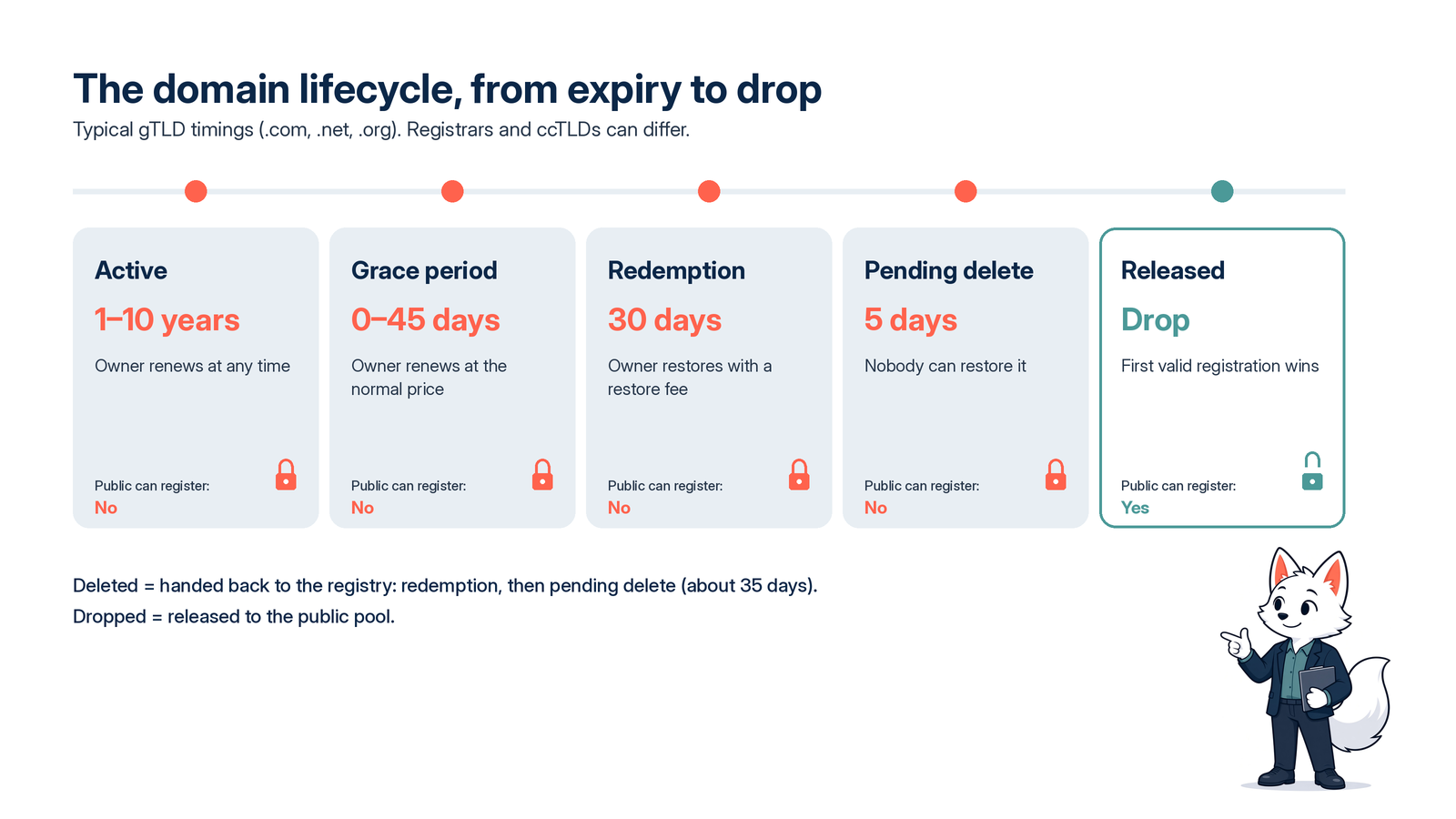
ICANN publishes a life cycle of a typical gTLD domain name. It runs in five stages, and every previously registered name you see on a list is sitting in one of them. Short definitions of each term are in our domain glossary.
Active registration
A name is active while someone pays for it. Terms run from one to ten years, and the owner can extend at any time. You can only get an active one by buying it from the current registrant, usually through the aftermarket.
End date and the grace period
When does a name lapse? On the end date in its public record, if nobody pays for another term. It then enters a window sometimes called auto-renew grace, which can last anywhere from 0 to 45 days depending on the provider.
During this window the owner can still extend at the normal price. So what happens in practice? ICANN's Expired Registration Recovery Policy makes the provider interrupt DNS before deleting the name, for at least the last eight days the owner can still act. If a page is shown in place of the site, it has to say the term has ended and explain how to fix it. The site goes dark and email stops arriving, and for a lot of owners that's the first sign anything went wrong. If it's your name, contact your registrar right away. For the full grace → redemption → pending delete timeline, day by day, see what happens when a domain expires.
The same policy allows deletion any time after the end date, which is why this window varies so much. Many large domain registrars, GoDaddy among them, let lapsing names go to auction during this window. If someone wins, the name moves to the buyer and never reaches the later stages.
Redemption period
The redemption period starts when the provider deletes the name and sends it back. Under the ERRP, operators must offer a 30-day redemption window after that. The site stays offline, transfers are blocked and the status changes in the public record. The old owner can still get the name back through the same company, but it's no longer a simple payment: there's a separate restore fee, which has to be published on the provider's site.
Nobody else can buy it at this stage, though you can set an alert or queue a catch request.
Pending delete
This is the last stop. After redemption ends, the name gets the pendingDelete status for 5 days. Nobody can restore it at this point, not even the old owner, and you can't register it yet. The EPP status codes page lists this status, along with redemptionPeriod and the other codes you'll see in a status check.
Drop-catch services build their queues of backordered names from this stage, because the drop day is predictable even when the exact minute isn't.
Release (domain drop)
At the end of those 5 days the record is purged and the name returns to the pool. That moment is the domain drop. The name opens up for public registration, and the first valid request wins.
What 20 real names showed in the registry
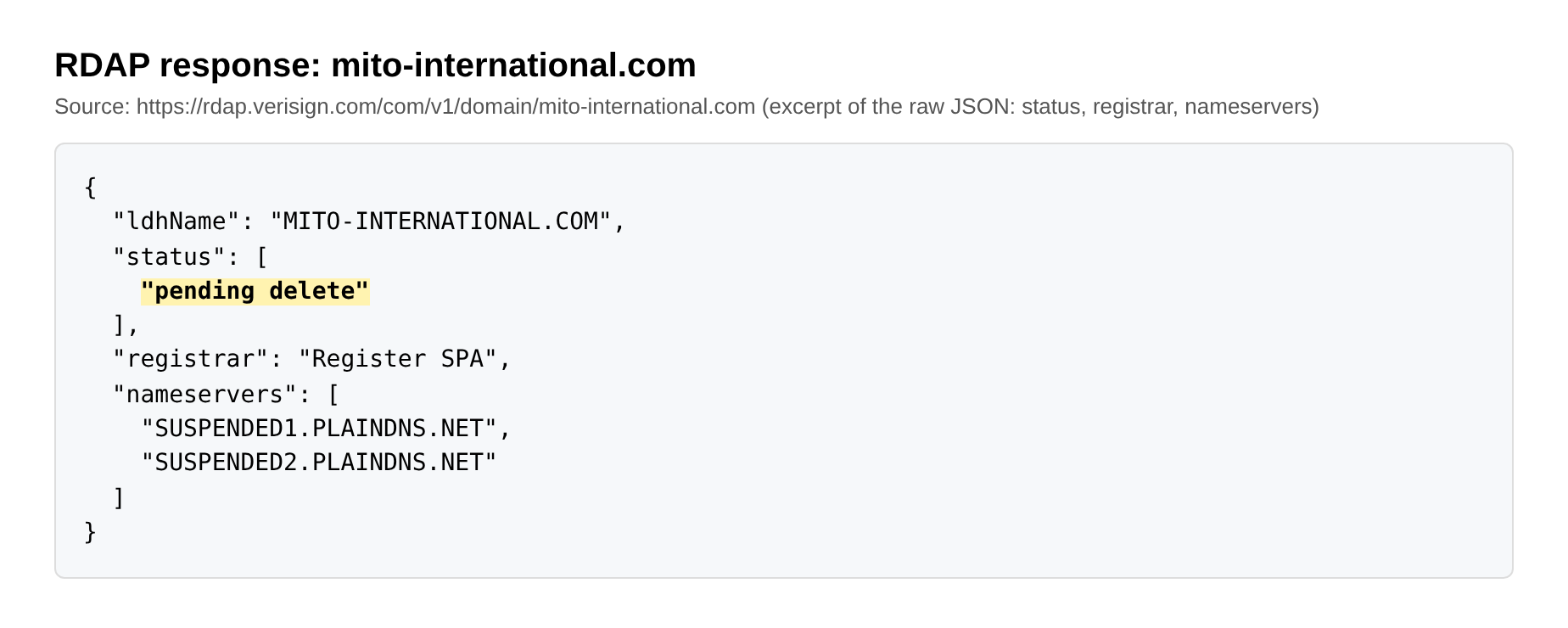
For this guide I ran two searches in Karma.Domains to see the timeline on real names. Both used our lapsed-names base with the same filters: .com only, Wayback age of 5 years or more, Moz Spam Score of 5 or less, sorted by Karma Score. The first batch was the top 10 names added in the past 24 hours. The second was the top 10 added three to six days earlier. Then I looked up all 20 in Verisign's RDAP service for .com (RDAP is the modern replacement for the old text-based protocol). Treat the result as a one-day snapshot of 20 .com names, not a statistic.
Here's what came back:
- 13 names were in the redemption period.
- 3 were in the final 5-day lock.
- 3 were gone entirely, which means they had dropped and anyone could register them.
- 1, fovizo.com, had already been registered again. It entered our base at 12:05 UTC, and the record shows a fresh one-year term at Namecheap at 13:27 UTC the same day.
The gap between the end date and the delete date shows how wide the 0 to 45 day range is in practice. I used the RDAP "last changed" date, which for these names lines up with the moment they went into redemption. Joker deleted anjomanweb.com 30 days after its end date. Register SPA took 33 days for its names, REG.RU 39 to 40, Squarespace and Acens 42, and XServer 43. All of them are .com names under the same rules, and the delete dates still spread across two weeks.
The three names in the final lock fit the policy exactly. mito-international.com, held at Register SPA, lapsed 63 days before it switched to pendingDelete: 33 days of grace plus 30 days of redemption. Two more Register SPA names, exit-pastificiourbano.com and exit-gastronomiaurbana.com, followed the same 63-day path.
What is an expired domain?
It is a name that has passed its end date without being paid for again. The previous owner still holds it through grace and redemption, so it isn't automatically available, whatever the label on a list suggests.
Our expiry checker shows where a name stands: its dates and the days left.
In everyday use, the word is also an umbrella term. Marketplaces and forums call almost any name with a past owner, or any old expired website, by this label, including names already sold or caught.
What are deleted domains?
These are names the provider has removed from its account and returned to the central database. In strict terms, this starts the redemption period, so a freshly deleted name is still recoverable by its owner and is not for sale.
The word gets used in three ways, which is the source of most of the confusion:
- At the provider, "deleted" means the delete command has been sent. The name enters redemption.
- At the extension operator, a deleted name is one in redemption or the final lock. It ends with the purge.
- On marketplace lists, "deleted" usually means names that have already dropped or are about to, which is how many people use "dropped".
There's also a fourth, narrower case. A brand-new name can be deleted within the five-day add grace window. Under the ERRP those aren't subject to redemption, so the name can come back to the pool much faster than the usual cycle.
When a list says "deleted," check the status before you plan anything. "redemptionPeriod" means you're early, "pendingDelete" means the drop is days away, and no record at all means the name is free.
What is a dropped domain?
It's a name that went through the whole cycle and was released, so anyone can claim it. Both "dropped" and "domain drop" come from that moment: the name falls out of the database and back into the pool.
Two things set it apart from a never-registered name. It keeps its history. Existing backlinks, Wayback Machine snapshots on archive.org and any spam reputation don't reset with the new owner. And good names rarely stay available for long, because catch services send registration requests the moment a name is purged. That's drop catching, and you can see which names are headed there in our drop catching auctions list.
The names still free after the drop are usually the ones nobody fought over. In my batch, the three dropped names were still unregistered when I checked, while fovizo.com had a new owner less than an hour and a half after it showed up in our feed.
Registrar auctions vs backorders vs hand-registering a drop
Each stage has its own way to buy.
- Auctions (grace period). Many providers sell lapsing names before deleting them. You bid, and if the owner doesn't pay before the sale ends, the name transfers to you. This is the only way to get a name before it's deleted. Browse current lots in our expired domain auctions list.
- Backorders (redemption and the final lock). A catch service such as DropCatch, SnapNames or NameJet tries to register the name the moment it drops. Many charge only if they succeed. If several people want the same name through one service, it usually goes to a private sale between them.
- Hand registration (after the drop). If nobody catches the name, you register it like any other, anywhere. It's the cheapest option, but you only get the names nobody wanted badly enough to catch.
For a high-value name, bid early or use more than one catch service. For a niche name you'd like but don't need, wait for the drop and register it yourself.
Where to search expired domains, deleted and dropped names
Deleted and dropped names show up on provider sale pages, catch-service lists and aggregators that combine many sources. Those pages cover only their own inventory, and drop lists rarely carry the SEO metrics you need to judge a name. A good expired domain search lets you find expired names the way a normal domain name search works: by keyword, extension, length or whether the name has a hyphen. Thousands of names lapse and drop as domains daily, so comprehensive lists and proper search tools matter more than any single seller's page.
Karma.Domains collects lapsed, bidding, backorder and buy-now listings from 40 sources into one database of 13M+ domains, adding 400k+ new domains a day. The deleted and dropped names list is the entry point for any search before you buy domains. From there you can narrow it with 90+ filters for metrics, Wayback history, language, category and name patterns. For recent drops with real link profiles, and if you want to use expired names with history, the expired domains with backlinks and aged domains lists are already filtered for that.
If you work with an AI assistant, the same search is available through MCP (Model Context Protocol, a standard that lets an AI client call connected tools and data). Karma.Domains exposes 32 MCP tools for searching, checking ownership records and history, and tagging candidates. Our guide on how to connect an expired domain database to ChatGPT or Claude walks through the setup.
How to vet deleted names and expired domain SEO value
A deleted name comes with someone else's history, so check it before you pay. Professionals and any marketer buying a registered domain for a project use roughly the same order, and most of it needs only free SEO tools:
- WHOIS status and dates. Run the name through the WHOIS lookup to confirm the stage and see the provider, creation date and nameservers.
- Real age. The creation date resets when a name drops, so it can't tell you how old the site is. The domain age checker reads the first Wayback Machine snapshot instead.
- Content history. Open the archive and look at what the site actually was. Pharma, casino or doorway pages in the past are a reason to walk away. Our guide to domain history lookup shows what to look for, and Karma Score rates that history from 0 to 100, which helps you sort a long list before you open each report.
- Spam signals. Check the spam score and look at the anchors in the link profile. Anchors in a language or niche the site never had are a classic warning sign.
- Links. Judge a profile by where the links come from, not by how many there are. A search engine treats a few relevant links better than thousands of directory ones, and a bad profile can undo your work. This checklist covers what a useful profile looks like.
For a full walkthrough of buying older names, see how to find and buy aged domains.
Frequently asked questions
What happens to expired domain names?
A lapsed name goes through grace, then redemption, then a 5-day lock. If nobody pays for it, wins it in a sale or restores it along the way, it is released and anyone can register it. Valuable names usually go to a catch service at the moment of the drop.
How can you tell when a domain has expired?
Check its public record. A past end date, an "autoRenewPeriod" or "redemptionPeriod" status, or a provider page saying the term has ended all mean it has lapsed. The expiry checker and the WHOIS tool show the dates and status in one place.
Are deleted domains legit to buy?
Yes. Buying one is a normal, legal way to get one once the previous owner has let it go. The risks are about history, not legality: spam, penalties or trademark problems carry over to the new owner. Check the archive and the links, and avoid names that match someone else's brand.
Can you recover a domain in pending delete?
No. Once a name has the pendingDelete status, nobody will restore it, not even for the original registrant. The last chance is the redemption period, through the same company. After the drop, the old owner has to register or catch it like everyone else. The page about lost domain names explains what options remain.
Can I recover a domain after it expires or is deleted?
Usually, yes, during the grace and redemption periods. Pay the normal price in grace, or pay the restore fee in redemption. Pending delete is final.
When do deleted domains become available to register?
After redemption and the final 5-day lock, when the record is purged. For .com and other gTLDs that is typically about 35 days after the name is deleted.
How do I evaluate an expired domain's SEO value and backlink profile?
Follow the five vetting steps above: status, real age, content history, spam signals and where the links come from.
Is a dropped domain the same as a deleted domain?
Not exactly. A deleted name is still held, in redemption or the final lock, and can't be registered. A dropped one has been purged and can. Many lists blur the two, so check the status.
Where can I see all expired domains?
No single source has every lapsed name, because providers, operators and catch services each publish their own. Karma.Domains combines 40 of these sources into one searchable database with 13M+ names and 90+ filters, so you can see lapsed, bidding and dropped names side by side.
Conclusion
Expired means the owner can still renew, and dropped means the name is free. Deleted ones are held centrally, and only the old owner can restore them during redemption. Look up the status first, then pick the buying route that fits the stage. To see what's dropping right now, start with the Karma.Domains database.