
Expired names show up for free in four places: registry zone files and the pending-delete lists built from them, auctions of names that weren't renewed, backorder and drop-catch services, and community spreadsheets or forum threads. They're fine for spotting candidates, but most entries are parked, spammy, already taken or not registrable yet.
Below is where those lists come from, what junk looks like, how to vet a name in a few minutes, and when a searchable database saves more time than a static file. I also ran one week of expired domains through Karma.Domains filters to show how much of a typical list survives a basic check.
Table of Contents
- Table of Contents
- Quick answer
- Where free expired domain lists come from
- What junk looks like in these lists
- What one week of expired domains looked like after filtering
- How to vet a domain from any free list
- When a searchable database beats a static list
- FAQ
- Can I find a list of expired domains for free?
- How can I retrieve an expired domain name?
- How do I find expired domains with good backlinks for free?
- Why does a domain on an expired list say it's not available?
- Where are expired domains for sale?
- How do I know if an expired domain was used for spam?
- What is the best free source of expired domains?
- What to do next
Quick answer
These lists come from four places: registry zone files and the pending-delete lists built from them, auctions of names that weren't renewed, backorder and drop-catch services, and community spreadsheets or forum threads. They're fine for spotting candidates. Most entries are parked, spammy, already taken or not registrable yet, so check status, history and backlinks before you spend anything.
Where free expired domain lists come from
They come from four sources: registry zone files and pending-delete lists, auctions of names that weren't renewed, backorder and drop-catch services, and community spreadsheets or forum threads. Every list is a copy of one of those sources, with some filtering or none at all, and the source tells you how fresh it is and what junk to expect.
| Source | What you get | How fresh | Typical junk |
|---|---|---|---|
| Zone files and pending-delete lists | Names about to drop, often the full daily set for a TLD | Daily | Everything, unfiltered: spam, parked pages, typos |
| Expired-domain auctions | Names the previous owner didn't renew, offered before deletion | Live, but you only see one seller's inventory | Names with inflated metrics, short auction windows |
| Backorder and drop-catch services | Upcoming drops with a backorder button | Daily | Popular names that already have several backorders |
| Forum threads, spreadsheets, "free list" downloads | A few hundred handpicked names | Whenever someone posted it | Stale names that dropped and were re-registered weeks ago |
Zone files and pending-delete lists
Most domain registries for generic TLDs share their zone files through ICANN's Centralized Zone Data Service, where anyone can request access. Compare two days of a zone file and you see which names left it, and a lot of free "deleting soon" lists start that way. The data is complete and costs nothing. It also has no quality filter at all, so you need your own tooling just to read it.
Auction lists
Large marketplaces list expired and expiring domains whose owners didn't renew after the registration period ended, usually during the grace period after expiration. You can browse these auctions without paying. The catch is coverage: each registrar shows only its own expiring names, and the metrics shown next to a listing are usually third-party numbers with no history attached.
Backorder and drop-catch services
Drop-catch services such as DropCatch publish lists of names that are about to be released, because that's how they sell backorders. The lists are free to browse. Good names on them often have several backorders already, which turns a cheap registration into an auction.
Community lists
Reddit threads, forum posts and shared spreadsheets are where most beginners start. Someone has already gone through a list of domains and done a first pass, which helps. A list posted last month is old news, though. When I checked a fresh batch of expired .com names for another piece, two of them were registered again about six hours after they appeared in our feed. Good names on a static list are usually gone before you read it.
What junk looks like in these lists
Junk is any name that would cost you money or a ranking problem if you registered it without checking. In free lists it usually falls into one of these groups:
- No real site in the archive. The Wayback Machine shows only parking pages, "for sale" landers, hosting defaults or error pages. There's no history to inherit.
- A spam past. The site sold pills, ran a casino, hosted adult content or was hacked and stuffed with doorway pages. Google's spam policies name expired domain abuse directly, with examples like commercial medical products on a former charity's domain.
- Bought links. The backlink profile is made of anchors such as "best casino bonus" or "cheap PBN links" from pages that exist only to sell links.
- Language or topic flips. An English small-business site that became a Japanese or Indonesian gambling site for its last few years.
- Not available. The name is still in redemption or pending delete, or someone already caught it. "Expired" on a list doesn't mean you can register it today. During redemption, the former domain owner can still restore the name.
- No data yet. Fresh names with blank metrics. That's normal for new entries, but a blank isn't a clean result.
The first two groups are the expensive ones. A spam history can follow a domain long after the content is gone, and you only find it by looking.
What one week of expired domains looked like after filtering
To put numbers on this, I ran a set of searches in the Karma.Domains expired base through our MCP server (Model Context Protocol, the standard that lets an AI client call connected tools). I used the same filters you'd use in the web app.
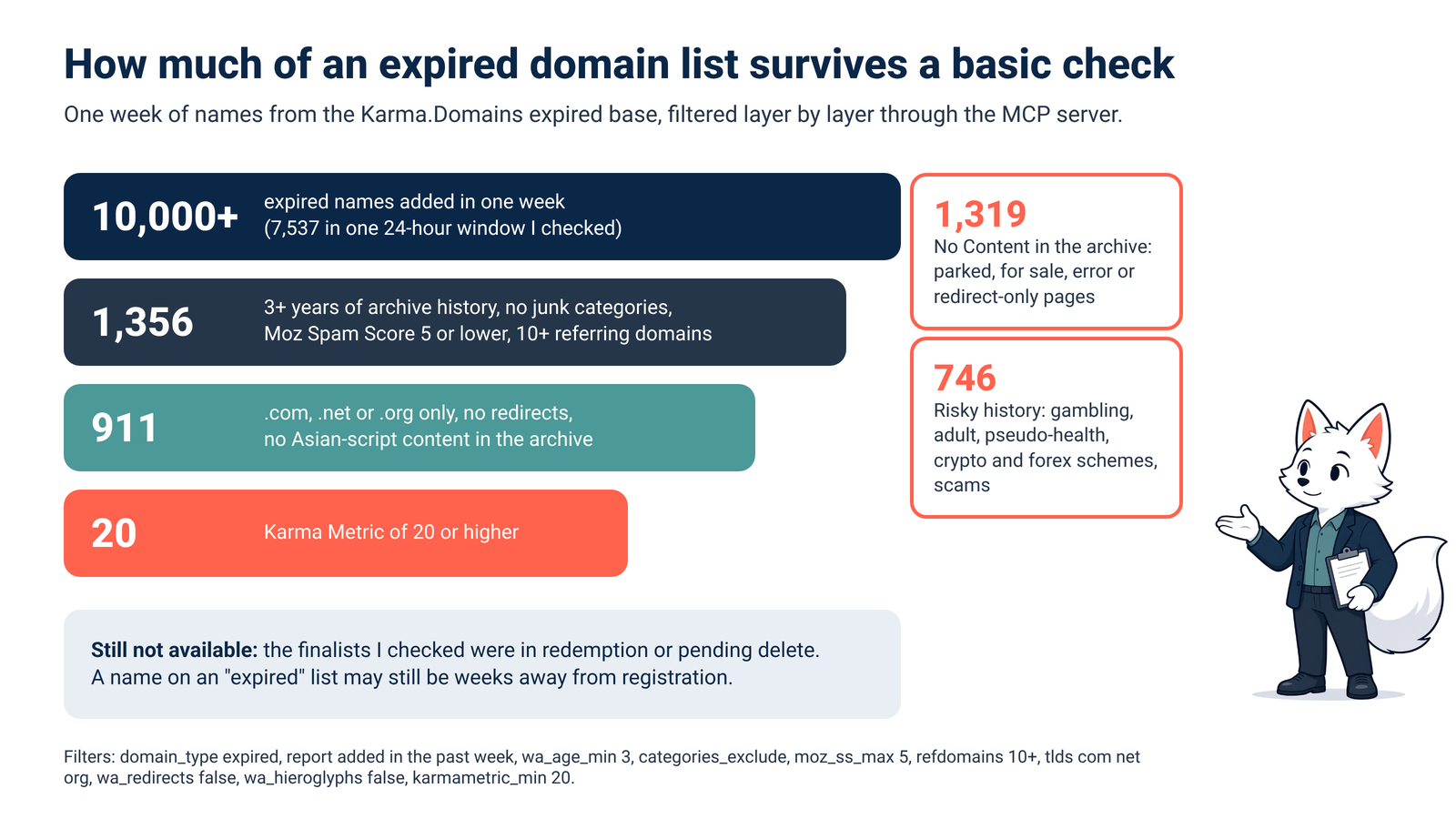
The volume first. In one 24-hour window I checked, the expired base took in 7,537 names. Across the seven days around that check the count passed 10,000, which is where the search stops counting exactly. Most of the very newest rows had no Moz or Ahrefs numbers yet. Karma.Domains collects report data in the background (archive content and Karma Score first, SEO metrics after that), so a name that appeared an hour ago looks empty even when it isn't.
Then the junk. Of the names added in that same seven-day window:
- 1,319 were categorized as No Content: parked, for-sale, hosting default, error or redirect-only pages in the archive;
- 746 fell into risky categories: gambling, adult, pseudo-health, crypto and forex schemes, scams and similar high-risk categories.
Then the filters, one layer at a time:
- Wayback history of at least 3 years, junk categories excluded, Moz Spam Score of 5 or lower, and at least 10 referring domains: 1,356 names left.
- Only
.com,.netand.org, no redirects in the archive, no Asian-script content: 911 left. - Karma Metric of at least 20 (our 0–100 score of how long and consistently the domain appeared in the archive, not a content-quality score): 20 left.
Two names from the run taught me more than the counts did.
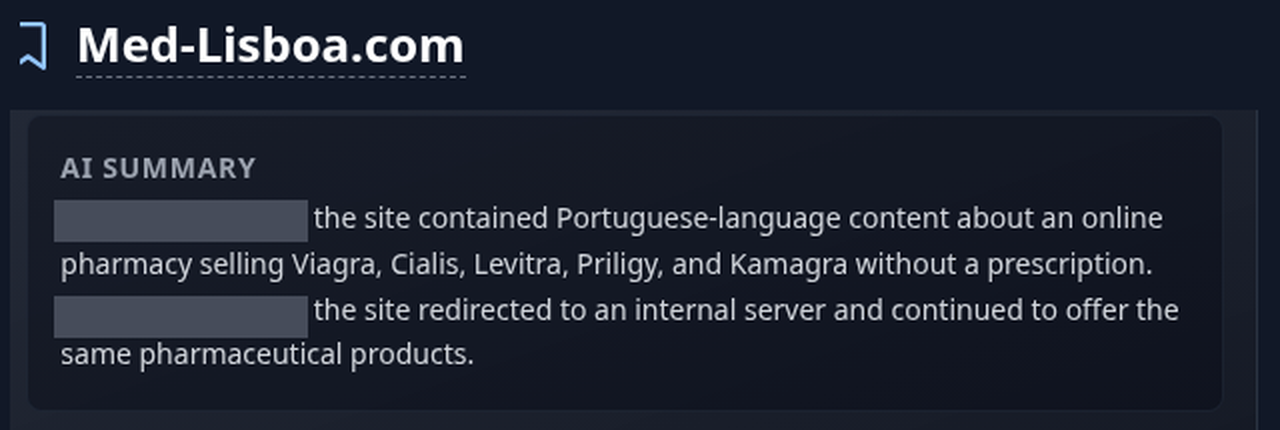
The first is med-lisboa.com. It passed every filter in the first layer: ten years of archive history, Moz Domain Authority 12, 115 referring domains in Moz, Spam Score 5. Our AI categorizer filed it under Health & Medical. The report's archive summary told a different story: for years the site sold Viagra, Cialis and other drugs without a prescription, in Portuguese. The two backlinks in the Moz sample both used the same anchor, "High Quality Dofollow Backlinks DA 50 PA 40 Premium PBN Network Service". Its Karma Metric was 3. Metrics alone would have put it on a shortlist. The archive and the anchors took it off.
The second is availability. I ran the live availability check in Karma.Domains on three finalists, including mucklehen.com, the old site of an Edinburgh animation studio with 21 years of archive history and 133 referring domains in Moz. All three came back as not available. Verisign's RDAP service for .com showed why: mucklehen.com and mahahartanah.com were in the redemption period, and the third finalist and med-lisboa.com were in pending delete. Every one of them sat on an "expired" list, and none could be registered that day. (If the stages are new to you, our guide to deleted, expired and dropped domains explains why a name can sit on an expired list and still be unrestorable that day.)

How to vet a domain from any free list
Run every candidate through seven checks: status, archive, anchors, spam signals, topic, a Google search, and trademarks. Before you bid, check with the auction or the company handling the name whether it can actually be registered or bought. A quick search engine check can surface scam reports, but it doesn't replace the archive and backlink review. Compare domain age with Wayback history too: age alone doesn't show whether the site stayed on topic.
Whatever list you start from, run each candidate through the same checks before you register or bid. Most take a minute.
- Check the status. Look up the name in a WHOIS lookup or RDAP. If the status says redemption period or pending delete, it isn't available yet. A domain expiry checker shows the dates and days left.
- Read the archive. Open the domain in the Wayback Machine and click through captures from different periods. You want one site that stayed on topic for years. Five owners in five years is a warning. Our guide to domain history lookup covers what to look for.
- Read the anchors. Open the backlink profile and scan the anchor text. Brand names and plain URLs are good signs. Casino, pharma and "buy links" anchors are a stop sign, whatever the authority numbers say. An anchor text checker gives you the distribution for one domain.
- Check spam signals. A spam score checker is a fast first filter, and a low score is still only one signal. med-lisboa.com scored 5.
- Match the topic. A former bakery blog with links from food sites is useful for a food project and close to useless for a SaaS site.
- Search Google for the name. Try
site:domain.comand the bare domain in quotes. No indexed pages is normal for a dropped name. Mentions on scam-report pages are not. - Check for trademarks. A name that matches a brand, a product or a typo of a well-known company can end in a dispute, even if the list marked it expired. Search the name plus "trademark" and skip anything that looks like a brand variant.
If a name passes all seven, it's worth a closer look at the backlinks themselves. Our article on expired domains with great backlinks goes deeper on link quality and relevance.
When a searchable database beats a static list
A static list is a snapshot. It was right when someone exported it, and it can't answer the questions you have about your own project: same topic, this language, this TLD, no gambling history, enough links. A searchable database answers those questions every time you ask. Instead of sorting one broad list, an expired domain search narrows results by topic, language and domain extension. Filters only build the shortlist, though: before you buy expired domain names, read the archive and backlink profile.
That's the trade-off I'd use to decide. If you're registering one or two names a month for a side project, a free list plus the seven checks above is enough. If you buy regularly for SEO projects, client sites or a portfolio, as domain investors do, the hours spent opening junk add up fast, and a saved filter does that first pass for you every day.
Karma.Domains is built for the second case. It holds 13M+ domains across 49 lists from 32 platforms and adds 400k+ new domains a day. You can search expired domains with 90+ filters on archive history, categories, spam signals, backlinks and name patterns. The parts that replace a static list are the ones that keep working after the first search:
- a saved filter runs the same criteria every day;
- email alerts and RSS feeds for saved filters send new matches as they appear (RSS is on the Pro plan);
- each report has the archive summary, categories and the backlink sample on one page, so the med-lisboa.com kind of name shows up before you spend anything;
- live checks confirm whether a name can actually be registered right now.
It still leaves the last call to you: twenty names out of more than ten thousand need someone to read the archive and decide.
FAQ
Can I find a list of expired domains for free?
Yes. They come from registry zone files and pending-delete lists, expired-domain auctions, backorder and drop-catch services, and community spreadsheets or forum threads. Most names still need a check, and a list is only a starting point.
How can I retrieve an expired domain name?
If the name is still yours, you can usually renew it during the grace period or restore it in redemption through your registrar. If it belongs to someone else, you can place a backorder or wait until it drops and then register that deleted domain. Seeing a name on an expired list does not mean you can register it today.
How do I find expired domains with good backlinks for free?
Start with a pending-delete or auction list, then check each candidate's backlinks and anchors with a free backlink or anchor text checker. Keep names whose links come from real, related sites with brand or URL anchors. Drop names with casino, pharma or link-selling anchors.
Why does a domain on an expired list say it's not available?
Expired isn't the same as available. After expiration a .com or other generic domain usually goes through a grace period, a 30-day redemption period and five days of pending delete before anyone can register it. That's when a domain becomes available, and not before. A WHOIS or RDAP lookup shows the current stage.
Where are expired domains for sale?
Expired-domain auctions and the aftermarket are the usual places. The auctions section above covers how those lists work and what junk to expect on them.
How do I know if an expired domain was used for spam?
Read its archive in the Wayback Machine across several periods, scan its backlink anchors, and search Google for the name. Spam history usually shows up as pharma, casino or adult content, a sudden language change, or anchors that sell links.
What is the best free source of expired domains?
There isn't one best source. Pending-delete lists are the most complete, auctions show names you can buy before they drop, and community lists save a first pass. The best choice is the one you can filter and check quickly for your own project.
What to do next
Pick one free list you already use and run its top ten names through the seven checks above. Count how many survive. If it's one or two, you've learned what that list is worth, and you can decide whether a filtered search is a better use of your time.