
Most “AI for SEO” workflows still begin and end in a chat window. You ask for a keyword list, an outline, or an audit summary. The model answers, and a person carries the result into the next tool. Agentic SEO, the practical use of AI agents for SEO work, moves part of that work outside the answer box. The agent can choose a tool, retrieve current data, apply a rule, inspect the result, and decide which step should come next. Ahrefs describes agentic SEO as applying AI agents to workflows so they can act, adapt, and recover rather than only generate text. That distinction is especially useful in domain research, where the work is repetitive but the final decision is not. (Ahrefs: What Is Agentic SEO?)
I think domain research is one of the cleaner places to use this model. The evidence is structured, the sequence can be described, and every expensive action can remain behind human approval.
Table of Contents
- Table of Contents
- What agentic SEO changes: chatbot, automation, and agent
- Why domain research fits an agent
- The stack behind agentic domain research
- A complete agentic domain-research workflow
- MCP, API, and webhooks have separate roles
- Guardrails make the agent useful
- How to start without building a large agent system
- FAQ
What agentic SEO changes: chatbot, automation, and agent
| Approach | What drives the next step | Good use in domain research | Main limitation |
|---|---|---|---|
| Chatbot | The user's next message | Explain a report or help design filters | It stops when the conversation stops |
| Fixed automation | Prewritten conditions | Pull a saved search every morning and add rows to a database | It handles exceptions poorly |
| AI agent | A goal, tools, state, and operating rules | Search, inspect, compare, annotate, monitor, and prepare a shortlist | It needs strong data contracts and clear authority limits |
An agent earns its place when it can operate on the research system: call the search tool, open reports, save state, and return evidence that another person can verify. Ahrefs makes the same point in its agentic SEO guide: an agent reasons no better than the model in a chat window, so the gain comes from tools, context, and the ability to recover from a failed step.
Agentic SEO is also easy to confuse with GEO. Agentic SEO concerns how work is performed; GEO concerns visibility in AI-generated search experiences. The terms overlap in conversation, but they describe different problems.
Why domain research fits an agent
Expired-domain research has four properties that agents handle well.
First, the candidate pool changes constantly. New domains arrive, auction prices move, bids change, and listings end. The process benefits from scheduled or event-driven runs.
Second, the first screening pass is rule-based. A team can specify TLDs, languages, topics, price ceilings, minimum age, authority signals, prohibited subjects, auction sources, and time before close.
Third, evidence comes from several layers. A domain may look strong by Domain Rating and still have an unrelated or toxic history. Another may have a clean archive and a commercial name but too little link value for the intended project.
Finally, the process has an obvious handoff point. An agent can reduce thousands of records to five candidates. A person still decides whether any of those five should be purchased.
The stack behind agentic domain research
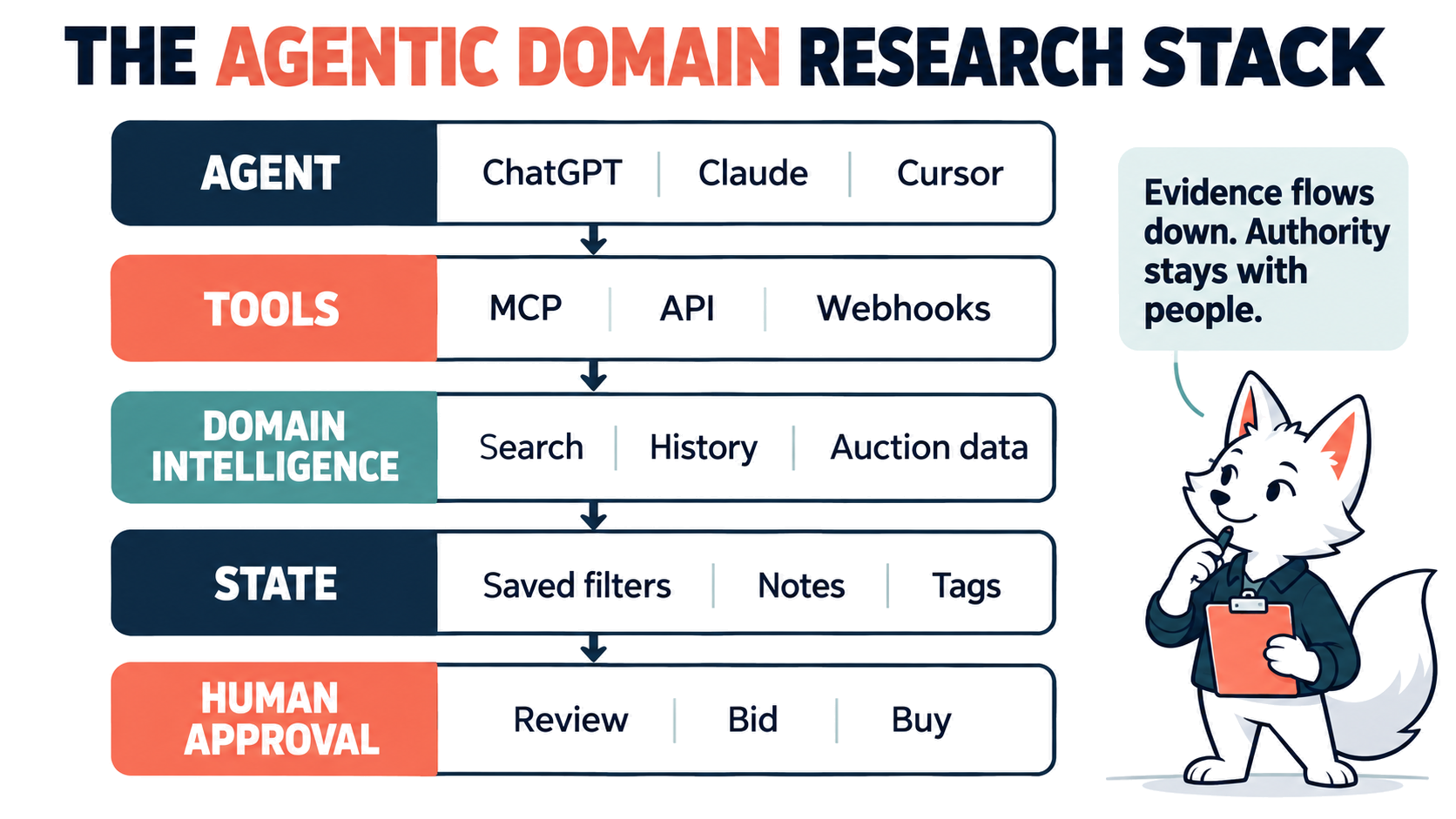
A practical stack has five parts.
- An agent environment. This may be ChatGPT, Claude, Cursor, an orchestration platform, or a hosted agent that can run on a schedule.
- Professional data tools. MCP (Model Context Protocol) servers and APIs connect the agent to current domain, backlink, traffic, auction, and search data.
- Reusable operating instructions. A skill or workflow defines the team's criteria, output format, budget rules, and escalation conditions. Search Engine Land's guide to SEO agent skills makes the same case: give the agent tools, templates, and a reviewer rather than a longer prompt. (Search Engine Land: How to build SEO agent skills that actually work)
- State. Saved filters, report IDs, notes, tags, and an external review queue prevent the agent from starting over each day.
- Human approval. A named person owns the bid, purchase, trademark review, and any exception to the rules.
Karma.Domains occupies the domain-intelligence layer in this stack. It is not a universal AI SEO agent for content, technical fixes, or publishing. The product gives agents access to the part they need for domain acquisition: discovery, historical screening, current auction data, and a review workflow.
The database holds 13M+ domains from 40 auction sources and adds more than 400,000 new domains a day on average. Search has 90+ filters across auction, expired, backorder, and buy-now inventory, and the MCP server exposes 31 tools for search, full reports, saved filters, notes and tags, share links, SEO Enrich, and live checks. Reports combine Wayback-based history analysis with available data from Ahrefs, Majestic, Moz, Semrush, Similarweb, and other sources. (Karma.Domains)
The size matters because an agent cannot recover candidates that never enter its tools. The filters matter because “find good domains” is not an operating rule.
A complete agentic domain-research workflow
Consider an SEO agency sourcing English-language domains for its B2B SaaS clients. Its daily brief might be:
Every morning, find new
.comand.ioauction domains whose archived content covered B2B software, SaaS tools, or business technology. Keep the current price below $1,000 and at least 24 hours before close. Exclude adult, gambling, pharma, piracy, and obvious topic changes. Return no more than five candidates with report links, the historical topic, the strongest SEO signals, the main concern, and the current auction state. Do not bid or buy.
Here is what happens behind that prompt.
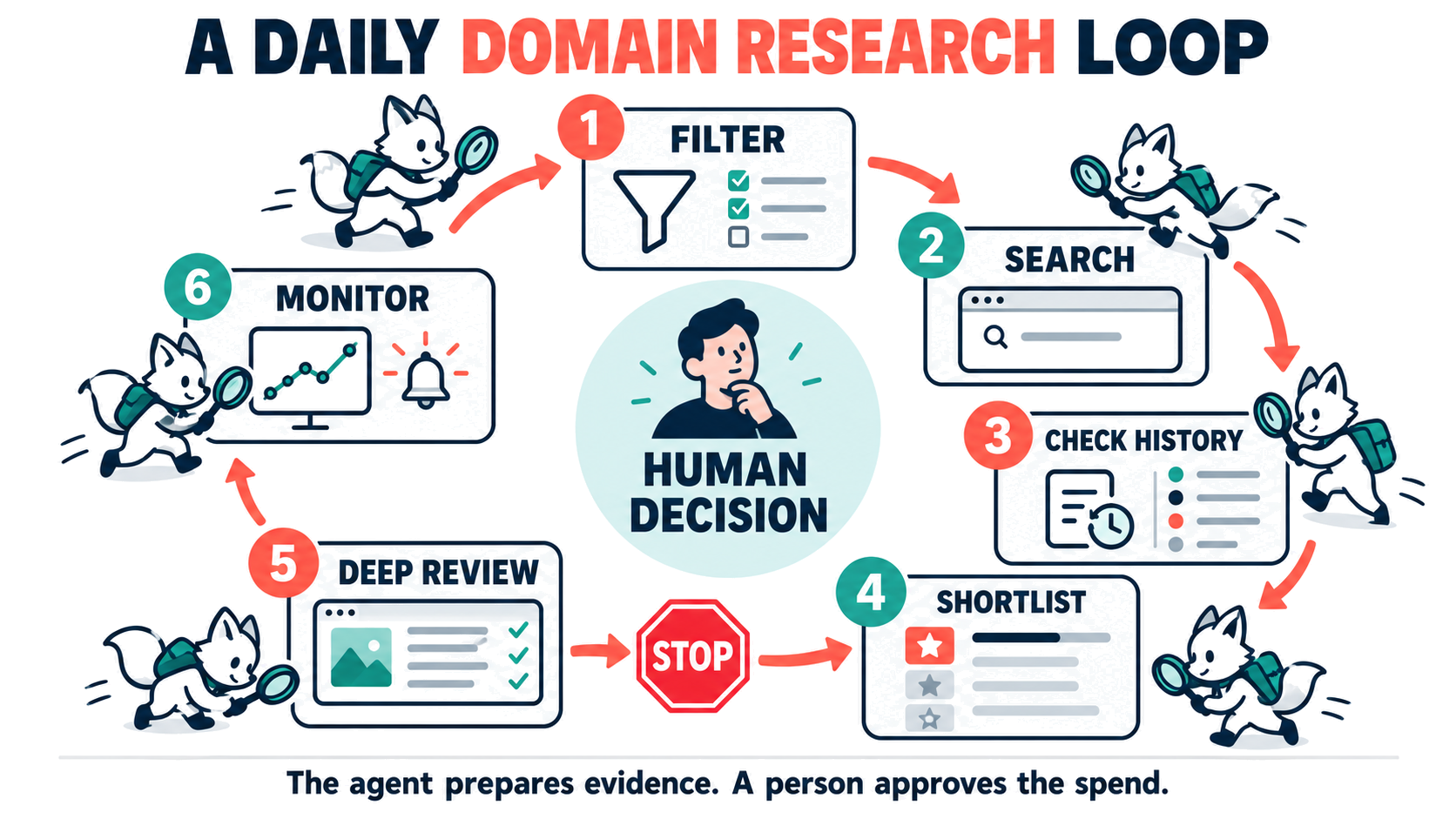
1. Translate the brief into structured criteria
The agent converts the niche, TLDs, language, price, timing, and risk rules into supported filters. It should expose those choices in the output. Hidden criteria are hard to debug.
The agent can then save the filter under a stable name such as b2b-saas-agency-v1 with save_saved_filter. If the team changes its minimum age next week, the agent updates that saved definition instead of inventing a new search every run.
2. Search current inventory
The agent calls search_reports over auction and expired records instead of searching the open web. Each result carries a stable report_id and a link to the full report, so every later step can point back to the same evidence.
At this stage I would use broad thresholds. A strict requirement for every possible metric can delay or erase good candidates because different fields arrive at different times.
3. Screen the domain's previous identity
For each candidate, the agent calls get_domain, which returns the report link, metrics, and a Wayback summary, and checks archived topics, languages, redirects, server behavior, content changes, and risk categories. A reviewer opens the report link for the snapshot-by-snapshot history. This is where a plausible domain name often fails.
SEO metrics remain useful, but they do not answer the identity question. The old site may have started as a SaaS or tech blog, then turned into a coupon farm or a casino affiliate site. A single current score compresses that history too aggressively.
4. Handle missing data deliberately
Most Karma.Domains reports already contain SEO data. If a shortlisted report is missing a field that the decision requires, the agent can start SEO Enrich with enrich_report_seo and poll get_enrich_report_seo_job until the job completes. Enrich is an exception path for missing data, not a routine refresh for every record.
5. Compare survivors and preserve state
The agent tags the surviving reports with the project and review stage through set_report_annotation, then adds a short note with the main reason to inspect or reject each domain. create_share_link gives a senior reviewer or client a guest link to the same report.
This step is easy to underestimate. Without saved state, the same domain reappears in tomorrow's run and consumes another review cycle.
6. Spend premium data on a short list
Ahrefs, Semrush, and DataForSEO all offer SEO MCP servers, so the same agent can pull deeper backlink and keyword data. Use them after the history-first screen, when perhaps five or ten domains remain. The agent can then inspect anchors, referring-domain concentration, lost links, ranking history, demand, or competitor fit in greater depth.
The order controls cost and attention. Pulling expensive reports for every raw match wastes both. Karma.Domains live checks follow the same logic: spam_score_checker, whois_lookup, or check_domain_expiry return a current value for one supplied name and use credits (cache hits are free), so they belong on the shortlist too.
7. Monitor the records that matter
Karma.Domains webhooks can send signed JSON to n8n, Zapier, Make, IFTTT, or another HTTPS endpoint when a report starts matching the filter conditions sent with the subscription, so the workflow does not depend on a filter someone saved in the UI. A second subscription type watches up to 100 specific reports for price, bid count, ending-soon, and ended events. An account can hold 30 subscriptions and receive 5,000 deliveries a day. (Expired-domain webhooks)
An agent can use those events to update the review queue, write a row to a shared sheet, or prepare a new decision brief for Slack, Telegram, or email. It should not notify the team every time a low-value field changes. The attention budget belongs in the workflow: five new candidates, one ending-soon alert, or a material price move.
8. Ask a human to decide
The final brief should include the report links, the rules applied, current auction data, evidence supporting the recommendation, missing fields, and the agent's main concern. One candidate entry might list the domain and report_id, the auction source, end time, and current price, the archived topic by period, the strongest link signal, any risk categories, and the fields that are still missing.
The reviewer then checks the archive, backlinks, marketplace listing, trademark risk, fit with the client's product category, and price ceiling. A confident paragraph from the agent is not approval.
MCP, API, and webhooks have separate roles
Karma.Domains exposes the same domain workflow through several interfaces.
- MCP fits interactive research. An analyst can change the brief in plain English, ask why a candidate survived, and write notes or tags back to the report.
- The Expired Domains API fits deterministic scripts, scheduled jobs, internal dashboards, and CRM integrations.
- Webhooks fit persistent monitoring. They push a new match or auction change into the automation instead of waiting for another polling cycle.
A mature workflow often uses all three. The API builds or synchronizes the queue. MCP helps an analyst review it. Webhooks wake the process when something changes.
Guardrails make the agent useful
Agentic workflows become unreliable when instructions define the goal but ignore operating limits. I would document at least these controls:
- a maximum result count and maximum tool-call budget per run;
- required evidence fields for a recommendation;
- clear treatment of null, stale, and conflicting values;
- deduplication by stable report ID;
- separate permissions for reading, annotation, and external actions;
- a rule that bids, purchases, and budget exceptions require confirmation;
- an audit record of the criteria and tools used.
The agent also needs a failure path. If a source is unavailable, the correct output is “not verified” with the affected candidates. It should not substitute a plausible number.
How to start without building a large agent system
Start with one saved search and one output format.
Connect the Karma.Domains MCP server to ChatGPT or Claude with an OAuth sign-in, or use a Bearer key in Cursor, Claude Code, or another IDE client. Your own Karma.Domains API key requires Pro, and the same key runs the API and webhooks; a free account starts with 5 bonus credits (10 with an invite). Ask the assistant to create the filter, run it, and return a five-domain shortlist with report links and concerns. Review that output manually for a week.
Once the criteria are stable, move the repetitive collection into the API or a scheduled agent. Add a webhook only when there is a person or system ready to act on the event.
That order keeps the research inspectable. The rules live in the saved filter and the operating instructions, so anyone on the team can read why a domain was kept or dropped, and a person still makes every decision that can spend money or create SEO risk.
FAQ
What is agentic SEO?
Agentic SEO is the use of AI agents that can call tools, check results, and choose the next step in an SEO workflow, with a person approving the decisions that matter. In domain research that means the agent searches, screens, and annotates candidates, and a specialist decides what to buy.
Is agentic SEO the same as GEO?
No. Agentic SEO describes how the work gets done. GEO, or generative engine optimization, is about visibility inside AI-generated answers. A team can use agents for GEO work, but the two terms answer different questions.
Can an AI agent buy expired domains on its own?
It should not. The Karma.Domains MCP server has no purchase or bidding tool, and a sound workflow keeps bids, purchases, and budget exceptions behind a named person's approval.
What does an agentic SEO workflow need for domain research?
Structured data it can query, such as an expired domain MCP server or API, written criteria for the niche and risks, a place to keep state like saved filters, notes, and tags, and a rule for what to do when data is missing or stale.